
Artificial intelligence is changing how businesses build software, manage information, and interact with customers. From intelligent customer-support assistants to automated document processing, organizations are exploring new ways to integrate AI into everyday operations.
However, building an AI application for a business requires more than connecting a chatbot to a language model. Organizations need reliable infrastructure, access to business data, security controls, scalability, and the ability to integrate AI with existing systems.
This is where Amazon Bedrock becomes important.
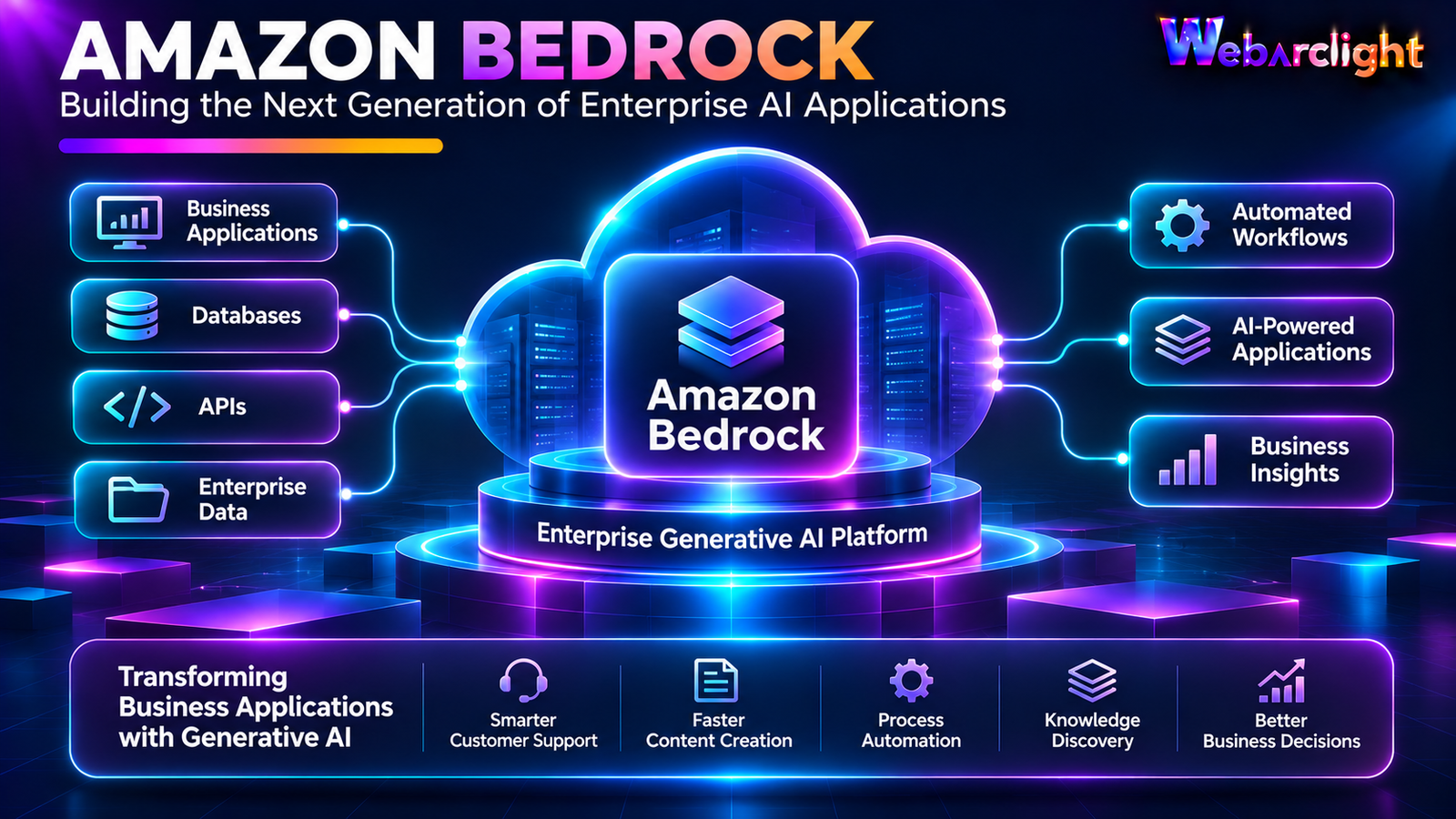
Amazon Bedrock is an AWS service that helps developers build generative AI applications using foundation models through managed APIs. It also provides capabilities for connecting business data, developing AI-powered workflows, applying safeguards, and creating intelligent applications.
Let's explore how Amazon Bedrock is helping businesses move from AI experimentation towards practical enterprise applications.
What Is Amazon Bedrock?
Amazon Bedrock is a fully managed service from Amazon Web Services (AWS) that provides access to foundation models from Amazon and other AI providers.
Instead of independently managing the infrastructure required to host and operate different models, developers can use Amazon Bedrock APIs to integrate foundation models into their applications.
It provides capabilities such as:
Access to different foundation models
Generative AI application development
Knowledge Bases and retrieval-augmented generation (RAG)
AI agent development capabilities
Model customization and evaluation
Security and responsible AI safeguards
This makes it easier for organizations to experiment with different AI capabilities and develop applications around their business requirements.
1. Building AI-Powered Business Applications
One of the biggest opportunities with Amazon Bedrock is the ability to integrate generative AI into existing business applications.
Organizations can use foundation models to build applications that understand natural-language requests, generate useful responses, summarize information, and assist users with complex tasks.
For example, businesses can develop:
AI-powered customer-support applications
Intelligent document-processing systems
Internal knowledge assistants
Business research tools
Automated reporting applications
AI-powered content and communication tools
Consider a company that receives hundreds of customer enquiries every day. An AI-powered application can understand incoming questions, retrieve relevant information, and prepare contextual responses for support teams.
This can reduce repetitive work and help employees focus on more complex customer requirements.
2. Connecting AI Applications to Business Data
A foundation model has general knowledge, but enterprise applications often need information that is specific to an organization.
This may include internal documents, product information, company policies, technical manuals, customer-service records, and operational information.
Amazon Bedrock Knowledge Bases helps connect foundation models with organizational data through Retrieval-Augmented Generation (RAG).
RAG allows an application to retrieve relevant information from connected sources and provide that context to a model before generating a response.
For example, an employee could ask:
"How many days of annual leave are available under our company policy?"
Instead of relying only on general model knowledge, an internal AI assistant can retrieve the relevant company policy and generate an answer based on that information.
This makes AI applications more useful for business-specific questions.
3. Moving Beyond Chatbots With AI Agents
Traditional chatbots generally respond to user messages. AI agents can go further by interacting with tools, accessing information, and completing multiple steps within a workflow.
For example, consider an AI-powered customer-service application.
When a customer submits a request, an AI agent could:
Understand the customer's request.
Retrieve relevant account information.
Check order or service details.
Identify the appropriate next step.
Interact with an authorized business system.
Prepare a response or complete an approved action.
Amazon Bedrock provides capabilities for building agentic AI applications, while Amazon Bedrock AgentCore provides infrastructure and tools to help developers deploy and operate agents in production environments.
This creates opportunities for businesses to move from basic conversational interfaces towards more intelligent workflow automation.

4. Automating Document Processing
Many organizations still spend considerable time reviewing documents and extracting information manually.
Invoices, contracts, applications, reports, forms, and business records often contain information that needs to be identified, summarized, or transferred into other systems.
Generative AI applications built with Amazon Bedrock can assist with:
Document summarization
Information extraction
Contract review support
Invoice data processing
Classification of business documents
Question answering across document collections
For example, an organization could build an application that processes incoming business documents, identifies important information, and prepares structured outputs for employee review.
This can help reduce repetitive administrative work and improve information accessibility.
However, sensitive or legally significant outputs should still be reviewed by authorized employees.
5. Improving Customer Experience
Customer expectations continue to increase. Businesses need to provide relevant information and support across multiple communication channels.
Amazon Bedrock can help organizations build AI-powered customer experiences that understand natural-language questions and retrieve relevant information.
Possible applications include:
Intelligent customer support: AI assistants can answer common questions using approved company information.
Product recommendations: AI applications can help customers explore products based on their requirements.
Personalized assistance: Applications can provide contextual responses based on permitted customer information.
Service automation: AI agents can assist with service requests and connect customers with the appropriate business processes.
When implemented correctly, these applications can help businesses improve response consistency and make customer interactions more efficient.
6. Building AI Applications With Stronger Security
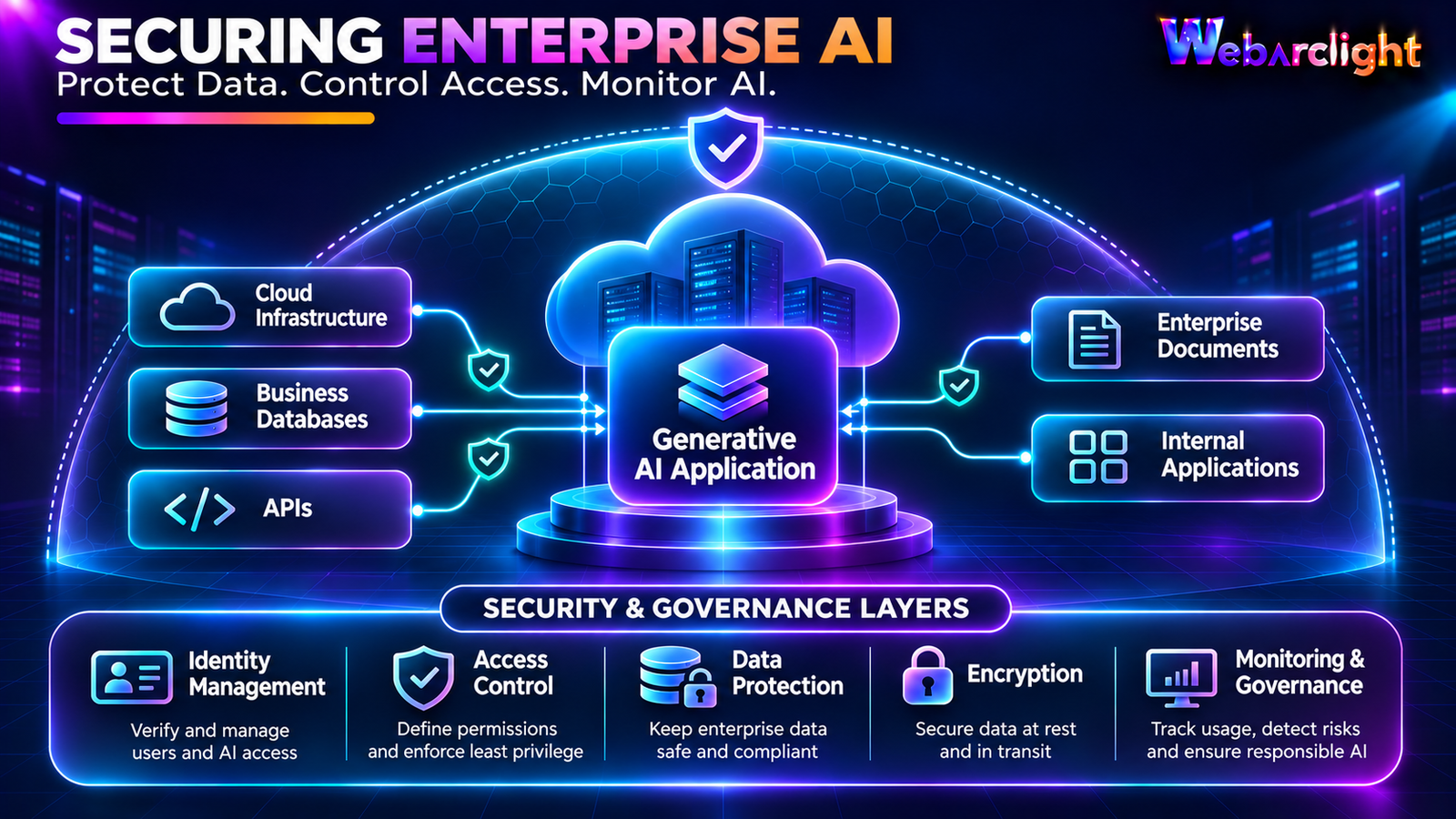
Enterprise AI applications often interact with sensitive business information. This makes security an essential part of the development process.
Amazon Bedrock provides security-related capabilities that organizations can use when building generative AI applications.
These include:
Integration with AWS identity and access management
Encryption and access controls
Private connectivity options
Monitoring and logging integrations
Configurable AI safeguards through Guardrails
Amazon Bedrock Guardrails can help evaluate user inputs and model responses against configured policies. Depending on the configuration, safeguards can address harmful content, denied topics, sensitive information, and other application-specific requirements.
Businesses should also implement appropriate controls around connected data sources, APIs, credentials, and AI-agent permissions.
Security should be designed into the complete application rather than added after development.
7. Scaling AI Applications With AWS Infrastructure
An AI application may initially serve a small group of users. As adoption increases, the application may need to support more requests, larger datasets, and additional business workflows.
Building for this growth requires suitable cloud infrastructure.
Amazon Bedrock provides managed access to foundation models, while other AWS services can support the surrounding application architecture.
For example:
Amazon S3 can store documents and application data.
AWS Lambda can execute event-driven application logic.
Amazon API Gateway can expose application APIs.
Amazon CloudWatch can help monitor application activity.
AWS databases can store structured application information.
By combining these services, organizations can build application architectures that support changing workloads and business requirements.
The right architecture depends on the application's expected traffic, latency requirements, data needs, and operating costs.
8. Managing AI Application Costs and Performance
Building an AI application is not only about selecting a powerful model.
Organizations must also consider how frequently the application will be used, how much information each request processes, and what level of performance users expect.
Important considerations include:
Choosing an appropriate foundation model
Monitoring token consumption
Evaluating response quality
Managing application traffic
Optimizing prompts
Selecting suitable infrastructure
Tracking performance and operating costs
A smaller or more cost-effective model may be sufficient for routine tasks, while more complex requirements may need a different model.
Testing different approaches before deployment helps organizations balance performance, accuracy, and cost.
9. What Businesses Should Consider Before Adopting Amazon Bedrock
Although Amazon Bedrock provides useful building blocks, successful enterprise AI applications require proper planning.
Before starting development, businesses should consider:
Business objective: Identify the specific problem the application should solve.
Data readiness: Determine which business documents, databases, and information sources are required.
Model selection: Evaluate available models based on accuracy, performance, cost, and application requirements.
Integration: Identify which existing applications, APIs, and systems need to connect with the AI solution.
Security: Define permissions, data-protection requirements, and safeguards.
Testing: Evaluate response quality, reliability, and application behaviour under different conditions.
Monitoring: Track performance, usage, errors, and operational costs after deployment.
A clear implementation strategy helps businesses avoid building AI applications that are technically impressive but provide limited practical value.
The Future of Enterprise AI Applications
Enterprise AI is moving beyond basic chat interfaces.
Businesses are increasingly exploring applications that can understand information, interact with internal systems, support employees, and automate complex workflows.
Platforms such as Amazon Bedrock provide developers with building blocks to create these solutions using foundation models, connected business data, agent capabilities, and security controls.
The next stage of enterprise AI will depend not only on model capabilities but also on how effectively organizations connect AI with their existing infrastructure, data, and business processes.
Companies that approach AI adoption with clear objectives, strong security, and scalable architecture will be better prepared to turn experimentation into practical business applications.
Conclusion
Amazon Bedrock is helping simplify the development of generative AI applications by providing managed access to foundation models and capabilities for building connected, intelligent solutions.
From customer-support assistants and document processing to enterprise knowledge systems and AI-powered workflows, businesses have multiple opportunities to apply these technologies.
However, successful adoption requires more than choosing an AI model. Data integration, security, scalability, monitoring, and cost management are equally important.
At WebArclight, we help businesses explore modern AI, AWS cloud infrastructure, software development, and automation solutions to build practical digital systems around their operational requirements.
The future of enterprise applications is becoming more intelligent. The opportunity lies in building AI solutions that solve real business problems.
https://webarclight.com/
Comments
No Comments Yet
Be the first to share your thoughts!