
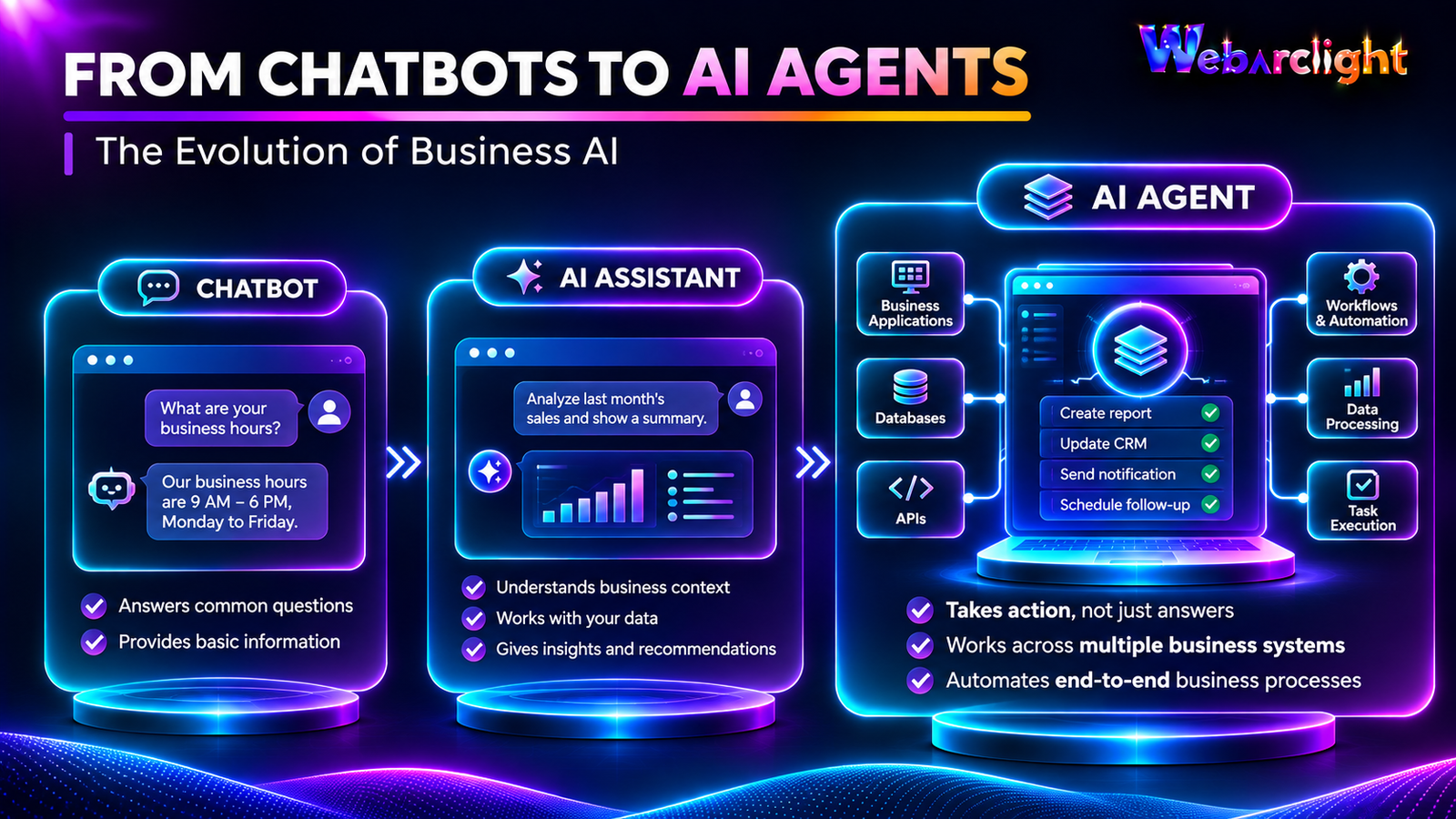
Artificial intelligence has changed significantly over the last few years. Businesses initially adopted AI through chatbots that could answer questions, provide information, and assist customers with basic enquiries.
Today, AI is moving beyond simple conversations.
Modern AI systems can understand business requirements, access information, use software tools, make decisions, and complete multiple steps within a workflow. These capabilities are creating a new generation of intelligent systems known as AI agents.
For businesses, this represents an important shift: moving from AI that responds to instructions towards AI that can help accomplish actual tasks.
Let's explore how business AI has evolved, what makes AI agents different from traditional chatbots, and how organizations can benefit from this technology.
1. The Beginning: Traditional Business Chatbots
Traditional chatbots were among the earliest widely adopted applications of business AI.
They were primarily designed to handle predefined questions and provide automated responses.
Businesses commonly used them for:
Answering frequently asked questions
Providing product information
Sharing business hours and contact details
Guiding customers through basic processes
Directing enquiries to the appropriate department
For example, a customer visiting an e-commerce website might ask:
"Do you offer free delivery?"
The chatbot identifies the question and provides a predefined answer.
These systems help businesses handle repetitive enquiries without requiring an employee to respond to every message.
However, traditional chatbots often struggle when conversations become complex or require information from multiple business systems.
2. The Next Step: AI-Powered Conversational Assistants
Generative AI introduced a major improvement in how businesses interact with artificial intelligence.
Instead of relying entirely on predefined responses, AI-powered conversational assistants can understand natural-language questions and generate contextual answers.
They can help with:
Summarizing business documents
Drafting emails and reports
Answering complex questions
Explaining technical information
Generating content
Assisting employees with research
For example, an employee can upload a business report and ask:
"Summarize the major operational challenges discussed in this document."
The AI assistant can analyze the document and generate a structured summary.
This makes AI more flexible and useful than traditional rule-based chatbots.
However, conversational assistants generally remain focused on understanding requests and producing responses unless they are connected to tools and permitted actions.
3. The Evolution Towards AI Agents
AI agents represent another step in the development of business AI.
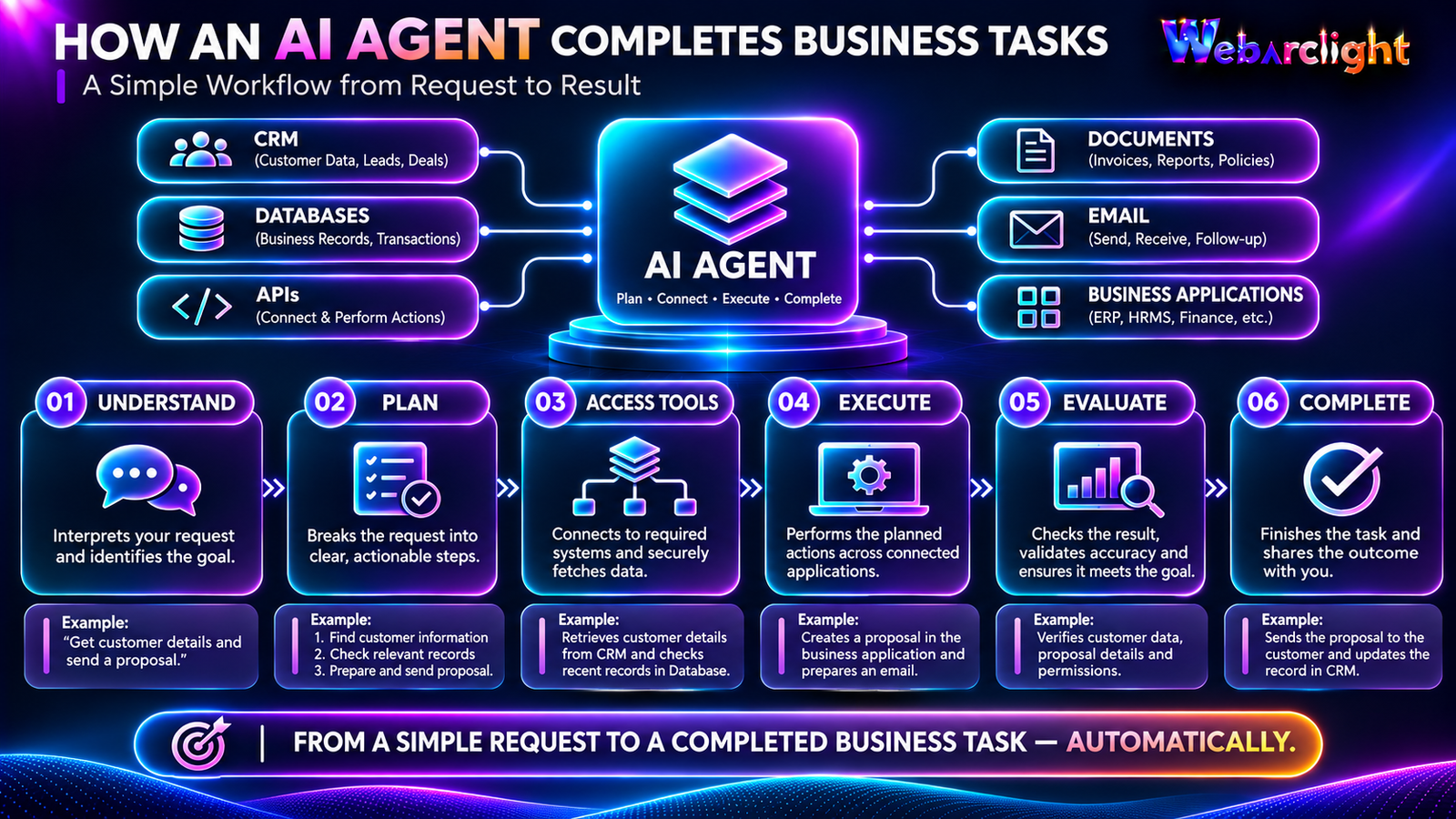
An AI agent can receive a goal, understand the requirements, determine the necessary steps, interact with available tools, and work towards completing the task.
For example, consider a customer asking:
"Please check my order status and update me about the delivery."
An AI agent connected to the appropriate business systems could:
Understand the customer's request.
Identify the required customer information.
Access the authorized order-management system.
Retrieve the latest order status.
Check available delivery information.
Prepare a relevant response.
Send the response through an approved channel.
Instead of simply explaining how to check an order, the agent can interact with the systems required to complete the workflow.
This is what makes AI agents particularly valuable for business operations.
4. Chatbots vs AI Assistants vs AI Agents
Although these terms are sometimes used interchangeably, they describe different capabilities.
| Capability | Traditional chatbot | AI assistant | AI agent |
|---|---|---|---|
| Answer questions | Yes | Yes | Yes |
| Understand natural language | Limited or rule-based | Yes | Yes |
| Generate contextual responses | Limited | Yes | Yes |
| Analyze documents | Limited | Yes | Yes |
| Access external tools | Usually limited | Sometimes | Yes, when configured |
| Complete multi-step workflows | Limited | Usually limited | Yes, within defined permissions |
| Make decisions during tasks | Rule-based | Limited | Yes, within defined boundaries |
| Perform business actions | Limited | Depends on integrations | Yes, with authorized access |
The key difference is not simply how intelligently a system communicates.
It is how effectively it can interact with business systems and complete tasks.
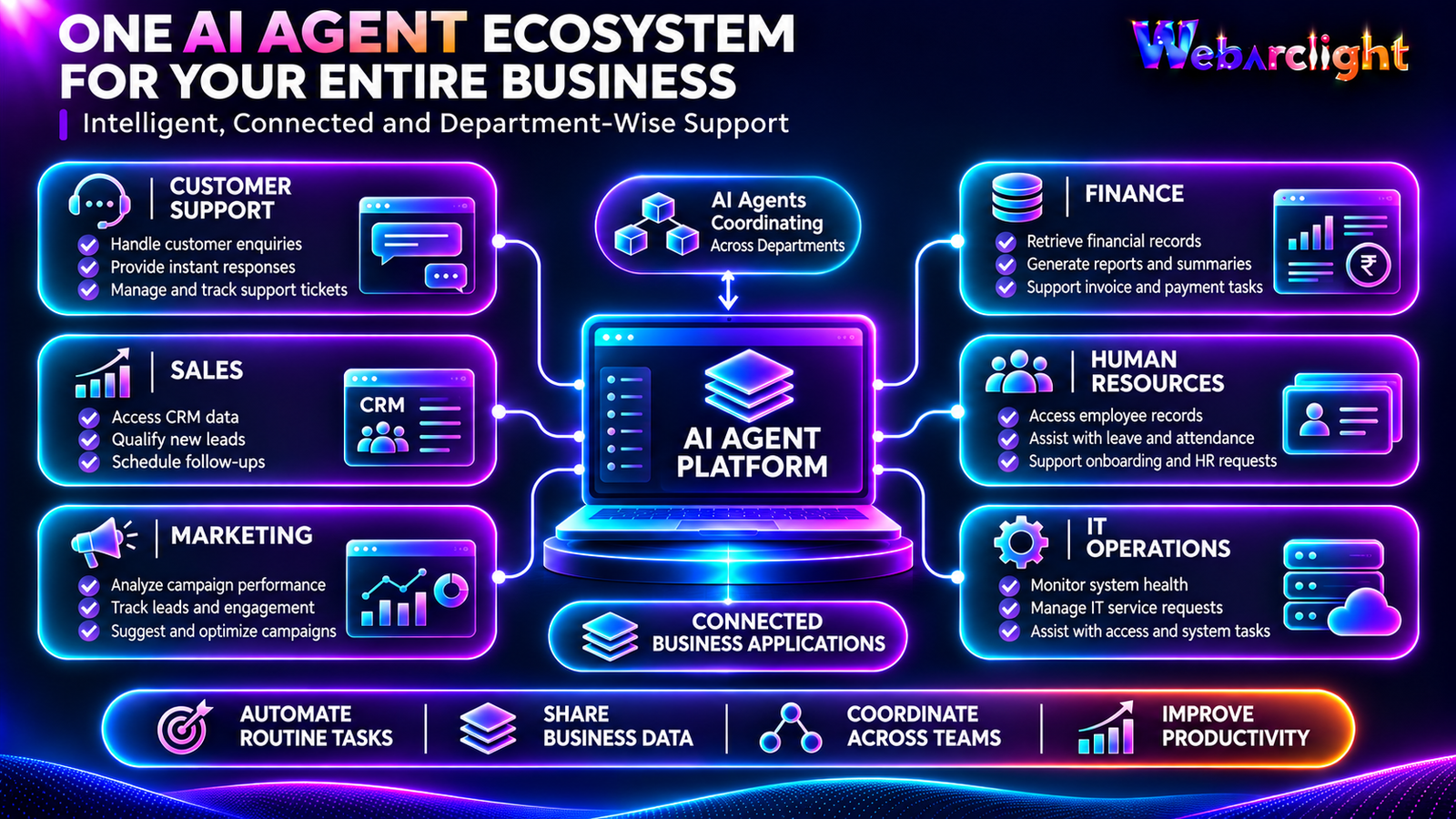
5. How AI Agents Are Changing Customer Support
Customer support is one of the most practical areas for AI-agent adoption.
Traditional chatbots can answer common questions, but more advanced AI systems can connect with customer databases, order-management platforms, and support applications.
For example, an AI-powered support agent could:
Understand customer complaints
Retrieve relevant account information
Check order or service status
Search approved support documentation
Prepare responses
Create support tickets
Escalate complex cases to employees
This can help reduce repetitive work while allowing support teams to focus on situations that require human attention.
Businesses should still ensure that sensitive customer information is accessed only through authorized systems and that important decisions can be reviewed by employees.
6. AI Agents in Sales and Marketing
AI agents can also support sales and marketing operations.
In sales, they may help teams organize customer information, prepare lead summaries, identify follow-up requirements, and update CRM records.
In marketing, agents can assist with research, campaign planning, content preparation, performance analysis, and reporting.
For example, a sales-support agent could receive a request to prepare a lead summary.
It could retrieve permitted CRM information, review previous interactions, identify the customer's requirements, and prepare a summary for the sales representative.
Similarly, a marketing agent could analyze campaign performance data and prepare a report highlighting important changes.
These applications can improve productivity, but employees should review important customer communications and business decisions.
7. AI Agents in Finance and Human Resources
Finance and HR departments handle many repetitive information-processing activities.
AI agents can assist with workflows such as:
Finance
Extracting information from invoices
Organizing expense records
Preparing financial summaries
Identifying unusual transaction patterns
Supporting payment workflows
Human Resources
Answering employee policy questions
Retrieving HR documentation
Assisting with onboarding processes
Organizing employee information
Preparing recruitment summaries
For example, an HR agent could help a new employee understand company policies by retrieving relevant information from approved internal documents.
However, sensitive activities such as payroll changes, employee record modifications, financial approvals, and recruitment decisions require appropriate access restrictions and human oversight.
8. The Technology Behind Modern AI Agents
AI agents depend on more than a language model.
They typically combine several technical components to understand requests and interact with business systems.
Foundation models: Help agents understand instructions, analyze information, and generate responses.
Tools and APIs: Allow agents to interact with external applications and services.
Business data: Provides the information required to complete tasks.
Memory and context: Help maintain relevant information during interactions and workflows.
Orchestration: Coordinates the steps required to complete a task.
Security controls: Define which systems, tools, and information an agent can access.
For example, an AI agent designed for an internal HR application may use a language model for understanding questions, a knowledge base for company policies, APIs for authorized HR operations, and access controls to protect employee information.
This combination turns a conversational interface into a more capable business application.
9. Multi-Agent Systems: When AI Agents Work Together
As businesses explore more advanced AI solutions, another concept is gaining attention: multi-agent systems.
A multi-agent system uses multiple specialized agents that collaborate on a larger task.
For example, an organization could develop a business-reporting workflow with:
A data agent that retrieves information
An analysis agent that identifies trends
A reporting agent that prepares summaries
A review agent that checks the output
Each agent performs a specific responsibility within the larger workflow.
This approach can help organize complex processes into smaller tasks.
However, coordinating multiple agents also introduces additional considerations around communication, permissions, monitoring, reliability, and cost.
Businesses should use multi-agent architectures when the problem genuinely benefits from specialized responsibilities rather than adding agents unnecessarily.
10. Security and Governance Become More Important
As AI moves from generating responses to performing business actions, security becomes increasingly important.
An AI agent connected to company systems may access customer records, internal documents, financial information, and operational applications.
Without proper controls, this can create unnecessary risks.
Organizations should consider:
Identity and authentication
Least-privilege access
Secure API integrations
Data protection
Monitoring and audit trails
Prompt-injection protection
Human approval for high-impact actions
Regular security testing
Businesses should also maintain an inventory of deployed AI agents and understand what each system can access and perform.
The objective is to make AI capable without giving it unrestricted authority.
11. How Businesses Can Start Using AI Agents
Organizations do not need to automate every department at once.
A practical approach is to begin with a specific business problem.
Step 1: Identify repetitive work
Find tasks that consume time and involve predictable business processes.
Step 2: Define the objective
Determine what the AI agent should accomplish and what success looks like.
Step 3: Identify required information
Understand which documents, databases, applications, and APIs are needed.
Step 4: Select the right technology
Choose suitable models, tools, cloud infrastructure, and integration methods.
Step 5: Establish security controls
Define access permissions, monitoring requirements, and approval procedures.
Step 6: Test the workflow
Evaluate the agent using normal requests, unexpected inputs, and potentially unsafe scenarios.
Step 7: Monitor and improve
Track performance, reliability, cost, and business value after deployment.
Starting with a limited use case allows businesses to evaluate the benefits before expanding AI across additional operations.
12. What Comes Next for Business AI?
The evolution of business AI is moving towards systems that can perform increasingly complex tasks.
Future business applications may combine conversational interfaces, specialized AI agents, enterprise knowledge systems, cloud infrastructure, and automated workflows.
Employees may increasingly interact with AI systems that can retrieve information, prepare work, coordinate tasks, and assist with everyday operations.
However, greater autonomy will also require stronger security, transparency, accountability, and governance.
The most successful implementations will not necessarily be the ones with the most advanced AI models. They will be the ones that connect AI capabilities to genuine business requirements.
Conclusion
Business AI has evolved from simple rule-based chatbots to conversational assistants and increasingly capable AI agents.
Traditional chatbots help answer questions. AI assistants help users understand and generate information. AI agents can go further by interacting with tools, accessing approved systems, and completing multi-step workflows.
For organizations, this creates new opportunities in customer support, sales, marketing, finance, HR, document processing, and business automation.
However, successful adoption requires more than technology. Businesses need reliable integrations, suitable infrastructure, secure data access, monitoring, and human oversight.
At WebArclight, we help businesses explore AI solutions, intelligent automation, cloud infrastructure, and custom software development to build digital systems around real operational needs.
The next generation of business AI will not just answer questions. It will help businesses get work done.
https://webarclight.com/
Comments
No Comments Yet
Be the first to share your thoughts!