
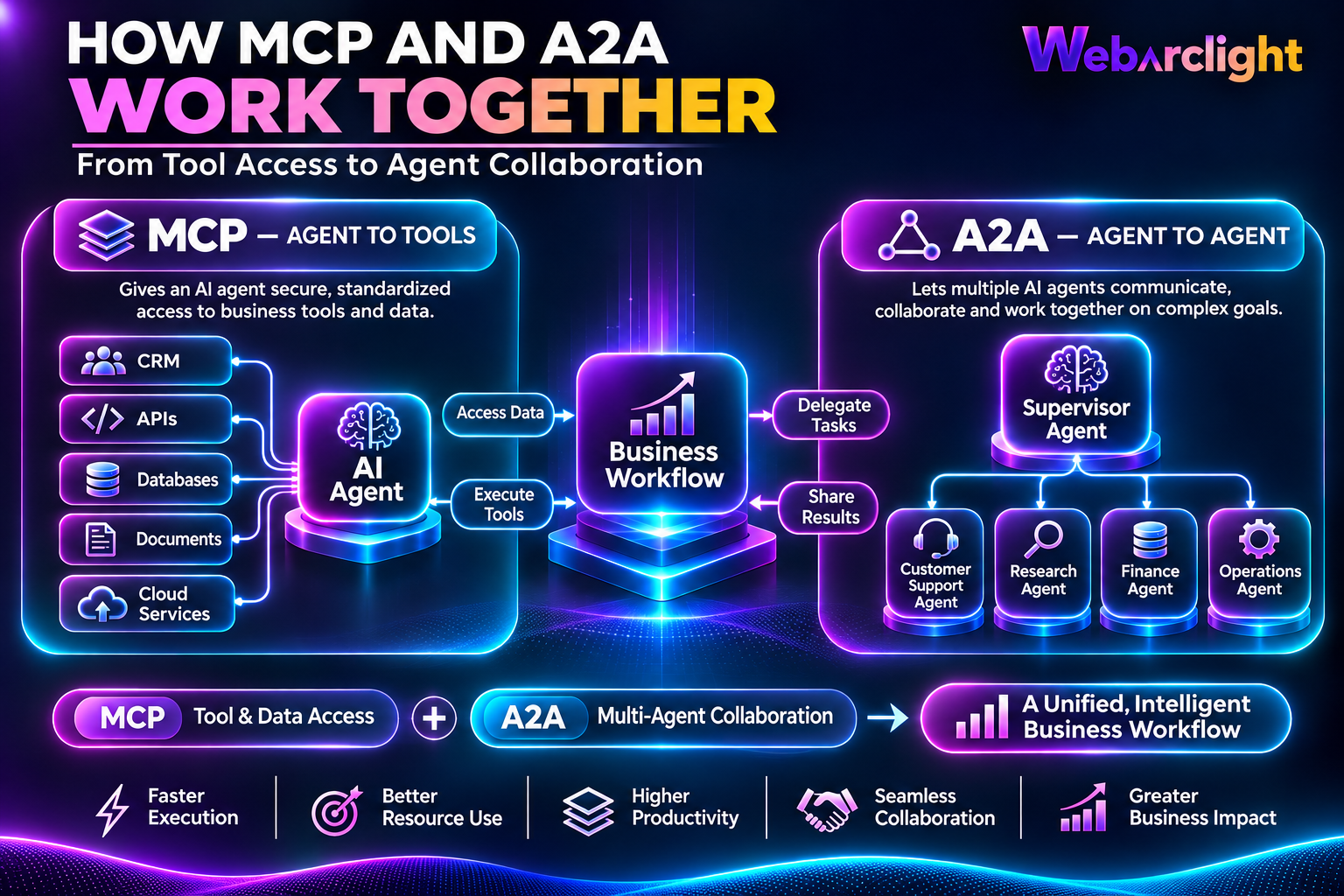
Artificial intelligence is moving beyond standalone chatbots and individual AI assistants. Businesses are increasingly exploring AI agents that can access company data, use external tools, communicate with other agents and complete multi-step tasks.
However, building connected AI systems requires more than powerful language models. Agents need a reliable way to interact with applications, access information and collaborate with other intelligent systems.
This is where two important technologies come into the picture: Model Context Protocol (MCP) and Agent2Agent (A2A).
Both are helping shape the future of agentic AI, but they solve different problems. Understanding how they work can help businesses and developers design more connected, scalable and flexible AI applications.
1. What Is Model Context Protocol (MCP)?
Model Context Protocol, commonly known as MCP, is an open standard that allows AI applications to connect with external tools, data sources and services through a consistent interface.
Traditionally, developers had to build separate integrations whenever an AI application needed to interact with a database, file system, CRM platform or external API.
MCP provides a standardized approach to these connections.
For example, an AI-powered business assistant could use MCP to:
Retrieve customer information from a CRM.
Access documents stored in cloud storage.
Query databases for business reports.
Interact with project management tools.
Retrieve information from internal company systems.
Instead of developing a completely different integration for every AI application, developers can build compatible MCP servers that expose specific capabilities.
In simple terms, MCP helps an AI agent connect to the tools and information it needs to perform a task.
2. What Is Agent2Agent (A2A)?
Agent2Agent, or A2A, is a protocol designed to enable communication and collaboration between independent AI agents.
Consider a business workflow where a customer submits a request for a product quotation.
Completing this request might involve several activities:
A customer support agent understands the request.
A product research agent retrieves relevant information.
A pricing agent calculates the estimated cost.
A documentation agent prepares the quotation.
A final review agent checks the response.
Instead of requiring one AI agent to handle every responsibility, A2A allows independent agents to communicate, delegate tasks and exchange results.
It is particularly useful when agents are developed using different frameworks, technologies or platforms.
In simple terms, A2A helps AI agents communicate and work together.
3. MCP vs A2A: What Is the Difference?
Although both protocols support agentic AI systems, their purposes are different.
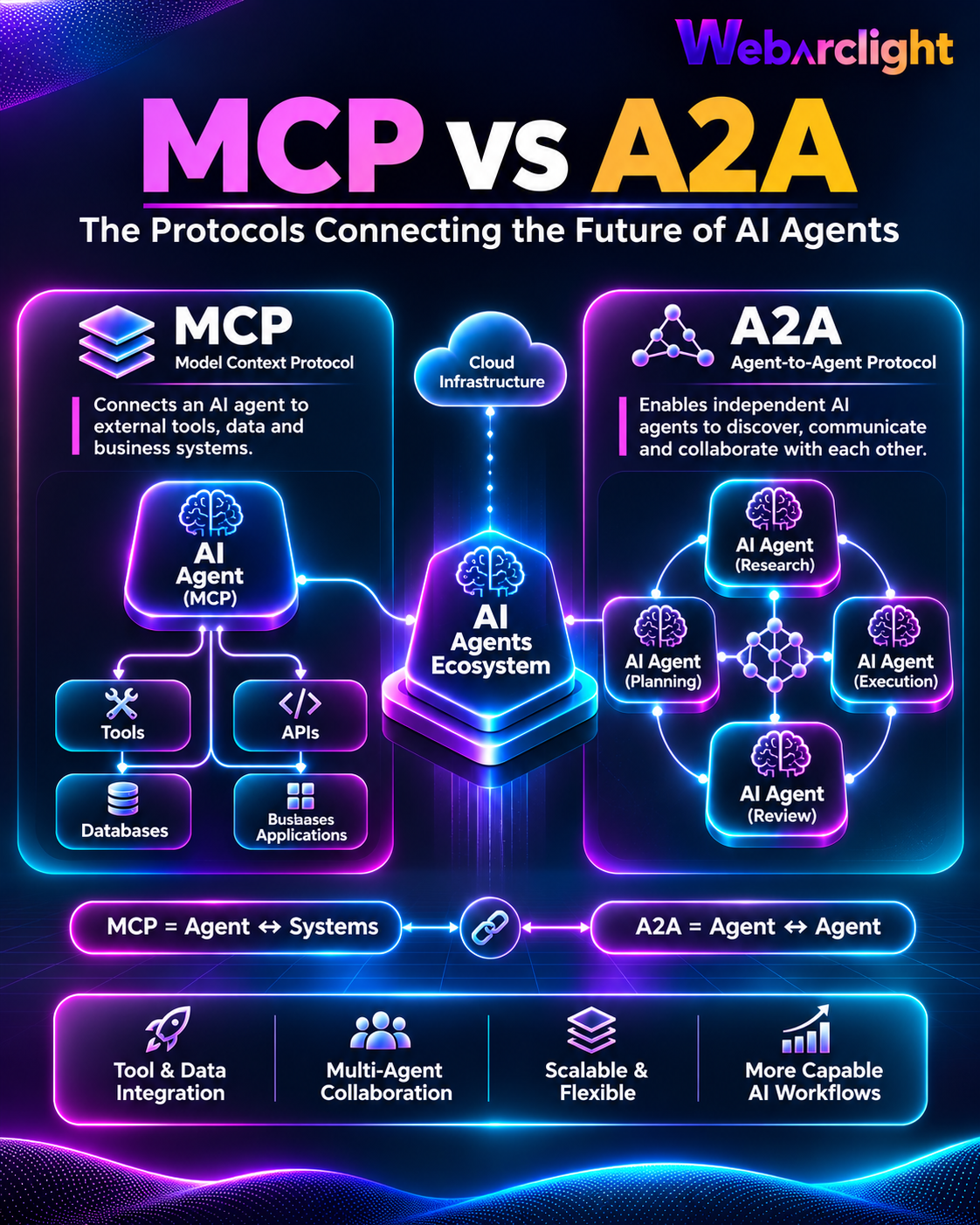
MCP focuses on connecting agents to tools and data, whereas A2A focuses on communication between agents.
| Comparison | MCP | A2A |
|---|---|---|
| Main purpose | Connect AI applications to tools and data | Connect independent AI agents |
| Communication | Agent to tool or data source | Agent to agent |
| Primary use | Tool access and information retrieval | Delegation and collaboration |
| Example | Accessing a CRM database | Asking another agent to analyse customer data |
| Typical workflow | Retrieve information or execute a tool | Assign a task and receive its result |
A useful way to remember the distinction:
MCP gives an AI agent access to its tools.
A2A allows an AI agent to collaborate with other agents.
They are not direct replacements for one another. A connected enterprise architecture may use both.
4. How MCP and A2A Work Together
The real potential becomes clearer when both protocols are used in the same business workflow.
Imagine an organisation developing an AI-powered customer service platform.
A customer submits a request about an existing order. The system may use multiple specialized agents to complete the task.
Here is how the workflow could operate:
Step 1: Customer request
The customer submits a question through the company's website.
Step 2: Main agent receives the request
A customer service agent analyses the request and identifies the information required.
Step 3: MCP connects the agent to business systems
The agent uses MCP to access the CRM, order database and relevant customer records.
Step 4: A2A enables agent collaboration
If the request requires additional work, the customer service agent delegates tasks to specialized agents, such as an order tracking agent or refund assessment agent.
Step 5: Agents complete their tasks
The specialized agents use their own tools and data connections to perform the required operations.
Step 6: Final response
The main agent combines the results and prepares a response for the customer.
This architecture allows businesses to build systems where agents can access information independently while collaborating on larger tasks.
5. Why Should Businesses Care About MCP and A2A?
For businesses, the value of these protocols is not simply technical innovation. Their importance lies in making AI systems more connected and useful.
Better integration with existing applications
MCP can help AI applications interact with existing business tools, databases and internal platforms without requiring every connection to be designed from scratch.
More flexible AI workflows
A2A enables specialized agents to handle different responsibilities. Businesses can expand workflows by introducing additional agents when new requirements emerge.
Reduced dependency on isolated AI systems
Instead of operating as separate assistants, AI applications can become part of a connected business environment.
Improved scalability
A modular architecture makes it easier to update individual agents, tools and integrations without redesigning the entire application.
Support for enterprise automation
Businesses can explore automated workflows across customer support, sales, finance, operations, document processing and IT management.
6. Security Considerations for Connected AI Agents
Connecting AI agents to business applications also introduces new security responsibilities.
An agent with access to customer records, financial information or internal systems must operate within clearly defined permissions.
Businesses should consider the following safeguards:
Access control: Give each agent only the permissions required for its assigned tasks.
Authentication: Secure connections between agents, tools and external services.
Data protection: Prevent sensitive business information from being exposed unnecessarily.
Human approval: Require authorization before high-impact actions such as financial transactions or sensitive data changes.
Monitoring: Maintain logs of tool calls, agent communication and important decisions.
Input validation: Validate requests and tool outputs before allowing agents to act on them.
MCP and A2A provide communication mechanisms; they do not automatically guarantee that an entire AI system is secure. Security must be designed into the application architecture.
7. How Businesses Can Start Adopting These Technologies
Organisations do not need to replace their existing software infrastructure to begin exploring connected AI systems.
A practical starting approach includes:
Identify repetitive workflows: Find business processes that require information from multiple systems or teams.
Start with one AI agent: Build a focused agent that solves a clearly defined problem.
Connect essential tools through MCP: Integrate the agent with the relevant databases, APIs and business applications.
Introduce A2A when needed: Add agent-to-agent communication when independent agents need to delegate tasks or collaborate.
Implement security controls: Define permissions, authentication, monitoring and approval requirements.
Measure performance: Evaluate accuracy, response time, reliability and operational cost before expanding.
Starting with a small, measurable use case can help organisations understand the benefits and limitations before moving towards larger agentic AI architectures.
8. The Future of Connected AI Applications
The development of AI is moving towards systems that can do more than generate text or answer questions.
MCP and A2A represent important parts of this transition. MCP helps standardize how AI applications access tools and information, while A2A supports communication between independent agents.
As AI ecosystems mature, businesses may increasingly combine these protocols with cloud infrastructure, secure APIs, orchestration platforms and enterprise data systems.
Technologies such as AWS, generative AI models, ChatGPT, Claude AI and other enterprise AI platforms can form part of these architectures, depending on the application's requirements.
The long-term opportunity is to build AI applications that can understand business objectives, access the right resources and coordinate tasks across multiple systems.
Conclusion
MCP and A2A address two important challenges in building connected AI applications: accessing external capabilities and collaborating with other agents.
MCP provides a standardized way for AI applications to interact with tools and data, while A2A enables independent agents to communicate and delegate work.
For businesses exploring agentic AI in 2026 and beyond, understanding these protocols is an important step towards building flexible, secure and scalable automation systems.
At WebArclight, we help businesses explore modern AI applications, cloud solutions and intelligent automation to build technology that supports real business needs.
https://webarclight.com/
Comments
No Comments Yet
Be the first to share your thoughts!