
Artificial intelligence is becoming part of everyday business operations. Organizations are using ChatGPT, Claude AI, generative AI applications, and autonomous AI agents to improve productivity, automate workflows, and make information more accessible.
However, as AI adoption grows, businesses face a new challenge: how can they use increasingly capable AI systems while maintaining security, accountability, and control?
An AI chatbot that answers questions presents different risks from an AI agent that can access company databases, send communications, modify records, or execute business workflows.
This is why AI governance is becoming an important part of enterprise technology strategy.
As businesses prepare for 2027, responsible AI adoption will require more than selecting powerful AI models. Organizations will need clear policies, appropriate permissions, monitoring, risk management, and human oversight.
What Is AI Governance?
AI governance refers to the policies, processes, technical controls, and responsibilities that guide how artificial intelligence is developed, deployed, monitored, and used.
It helps organizations ensure that AI systems operate according to business requirements, security expectations, and applicable regulations.
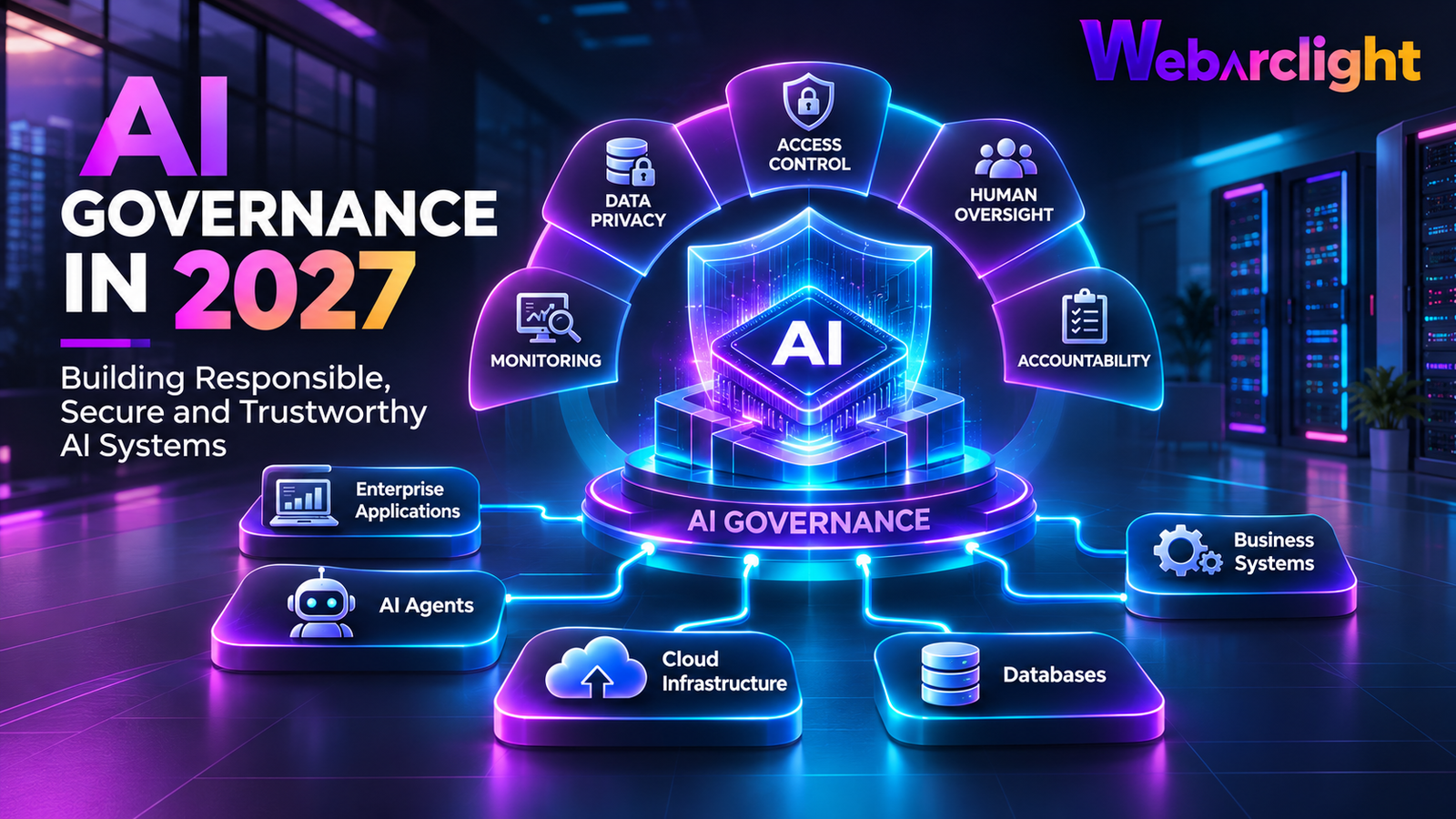
A practical AI governance framework should address:
Data privacy and protection
AI system security
Access permissions
Transparency and accountability
Human oversight
Model evaluation
Risk management
Monitoring and documentation
The objective is not to prevent businesses from using AI. It is to help them adopt AI in a controlled and responsible way.
1. Why AI Governance Is Becoming Important
AI systems are moving beyond simple content generation.
Businesses are connecting AI applications to customer databases, internal documents, cloud platforms, CRM systems, and operational software.
This creates new opportunities, but it also introduces additional risks.
For example, an AI agent connected to an HR platform may retrieve employee information or assist with onboarding. If it receives excessive permissions, it could potentially access information outside its intended responsibility.
Similarly, an AI-powered customer-support system may provide incorrect information or expose sensitive customer data if its integrations are not properly controlled.
Gartner has warned that governance gaps could cause enterprises to restrict or decommission autonomous AI agents. Its May 2026 forecast says 40% of enterprises could demote or decommission such agents by 2027 because of governance failures.
This makes governance an important consideration before AI systems reach large-scale deployment.
2. Managing AI Agents and Their Permissions
AI agents introduce a different governance challenge because they can interact with tools and perform actions.
Organizations should not give every AI agent the same level of authority.
For example:
A document assistant may only need read access to approved documents.
A customer-support agent may need access to selected customer records.
A sales agent may be permitted to update CRM information.
A finance agent may prepare payment recommendations but require human approval before execution.
This approach is based on the principle of least privilege.
Every agent should have a clearly defined purpose, identity, permission scope, and level of autonomy.
3. Protecting Business Data
Business AI applications often work with confidential information.
This may include customer records, employee information, financial data, contracts, internal reports, and intellectual property.
Organizations need to understand where their data is stored, how it is processed, and which AI systems can access it.
Important practices include:
Classifying sensitive information
Restricting access to approved data sources
Applying encryption
Protecting API credentials
Reviewing third-party AI integrations
Establishing data-retention policies
Monitoring information access
Businesses should also evaluate how information is handled by external AI providers and ensure that their configurations and agreements meet organizational requirements.
4. Shadow AI: A Growing Business Challenge
Shadow AI refers to the use of AI tools, applications, or agents without appropriate organizational approval or oversight.
Employees may independently use AI assistants, browser extensions, third-party platforms, or automation tools to complete everyday tasks.
Although this can improve individual productivity, it may introduce risks when sensitive company information is shared with unapproved services.
Businesses should respond by:
Identifying AI applications already being used.
Establishing approved AI tools and usage policies.
Educating employees about data protection.
Reviewing third-party integrations.
Monitoring unauthorized AI activity.
Providing secure alternatives for common business tasks.
The goal should be to encourage useful AI adoption while maintaining visibility and control.
5. AI Transparency and Accountability
Businesses should understand how their AI systems are being used and who is responsible for their outcomes.
For important workflows, organizations should maintain records covering:
Which AI system performed the task
Who initiated the request
What information was accessed
Which tools or integrations were used
What action was performed
Whether human approval was required
What the final outcome was
This information can help businesses investigate errors, review decisions, identify security incidents, and improve system reliability.
AI should not become an unaccountable layer between employees and important business decisions.
6. Human Oversight in AI-Powered Decisions
Not every task should be fully automated.
Some AI-assisted activities have financial, legal, operational, or reputational consequences.
Examples include:
Approving payments
Modifying employee records
Deleting business data
Sending sensitive communications
Changing production infrastructure
Making important customer decisions
For these activities, businesses should introduce human approval where appropriate.
An AI agent can collect information, analyze the situation, and recommend an action. An authorized employee can then review and approve the final decision.
This creates a balance between automation and accountability.
7. AI Risk Assessment and Continuous Monitoring
AI governance should continue after an application is deployed.
Models may change, new integrations may be introduced, permissions may expand, and business requirements may evolve.
Organizations should regularly evaluate:
Model accuracy and reliability
Security vulnerabilities
Unauthorized access
Data leakage
Prompt-injection risks
Unexpected agent behaviour
Application performance
Operating costs
The NIST AI Risk Management Framework provides a useful reference for organizations looking to manage AI-related risks across the AI lifecycle.
Its approach helps businesses think about identifying, measuring, managing, and monitoring AI risks rather than treating security as a one-time activity.
8. Governance Across ChatGPT, Claude AI, and Enterprise AI Platforms
Businesses may use multiple AI platforms depending on their requirements.
For example:
ChatGPT and GPT: Organizations may use OpenAI products and models for assistants, content workflows, research, coding, and custom AI applications.
Claude AI: Anthropic's Claude models can support document analysis, coding, conversational applications, and other business workflows.
Enterprise AI platforms: Services such as Amazon Bedrock help developers integrate supported foundation models into applications built on AWS.
Using multiple AI providers can offer flexibility, but it also makes governance more important.
Organizations should establish consistent policies covering data handling, identity, access, monitoring, model evaluation, and accountability across their AI environment.
The governance controls should reflect the actual capabilities and risks of each application rather than assuming every model or agent requires identical restrictions.
9. Building an AI Governance Framework for 2027
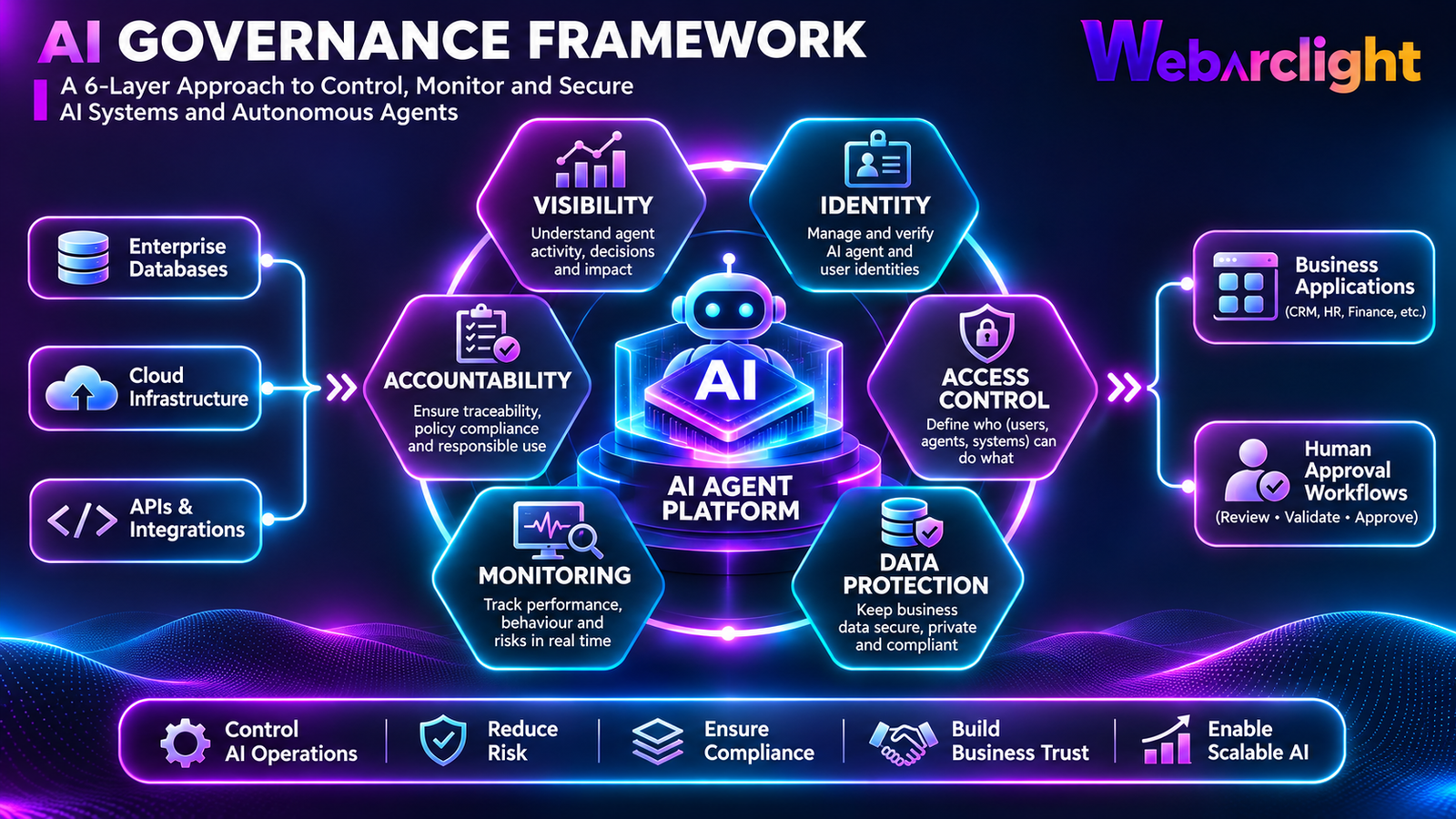
Businesses can begin with a practical framework built around six areas.
1. Visibility: Maintain an inventory of AI applications, models, agents, and integrations.
2. Identity: Assign appropriate identities and ownership to AI systems.
3. Access: Apply least-privilege permissions and restrict sensitive operations.
4. Protection: Secure business data, APIs, credentials, and infrastructure.
5. Monitoring: Track AI activity, performance, errors, and unusual behaviour.
6. Accountability: Define human approval requirements, documentation, and responsibility for important outcomes.
These controls can be introduced gradually, starting with the AI applications that have the greatest access to sensitive information or business-critical systems.
10. How Businesses Can Start Adopting Responsible AI
A practical AI governance strategy does not need to begin with a complicated enterprise-wide implementation.
Businesses can start with a few straightforward actions:
Identify the business processes currently using AI.
Create an inventory of approved AI tools and agents.
Classify the data used by each application.
Define access permissions and responsibilities.
Establish guidelines for employee AI usage.
Test AI systems before production deployment.
Introduce human approval for high-impact actions.
Review security and performance regularly.
As adoption grows, these practices can become part of a more comprehensive AI governance framework.
The Future of AI Governance in 2027
AI development is moving towards more capable models, autonomous agents, connected applications, and intelligent business workflows.
As these technologies become integrated into business operations, organizations will need stronger ways to understand and control what their AI systems can do.
The future of AI governance will likely place greater emphasis on agent identity, runtime permissions, continuous monitoring, risk-based controls, and accountability.
Businesses will increasingly need to answer three important questions:
What can our AI systems access?
What actions are they allowed to perform?
Who is responsible when something goes wrong?
Organizations that establish clear answers will be better positioned to adopt AI at scale.
Conclusion
AI governance is becoming an essential part of modern digital transformation.
As businesses adopt ChatGPT, Claude AI, generative AI applications, and autonomous AI agents, they must ensure that these systems operate securely, responsibly, and within clearly defined boundaries.
Strong governance does not have to slow innovation. When implemented correctly, it helps organizations build trust, reduce operational risks, protect business information, and deploy AI more confidently.
At WebArclight, we help businesses explore AI integration, secure software development, cloud infrastructure, and intelligent automation to build digital solutions around real business requirements.
The future belongs to businesses that do not just adopt AI, but know how to govern it responsibly.
https://webarclight.com/
Comments
No Comments Yet
Be the first to share your thoughts!