
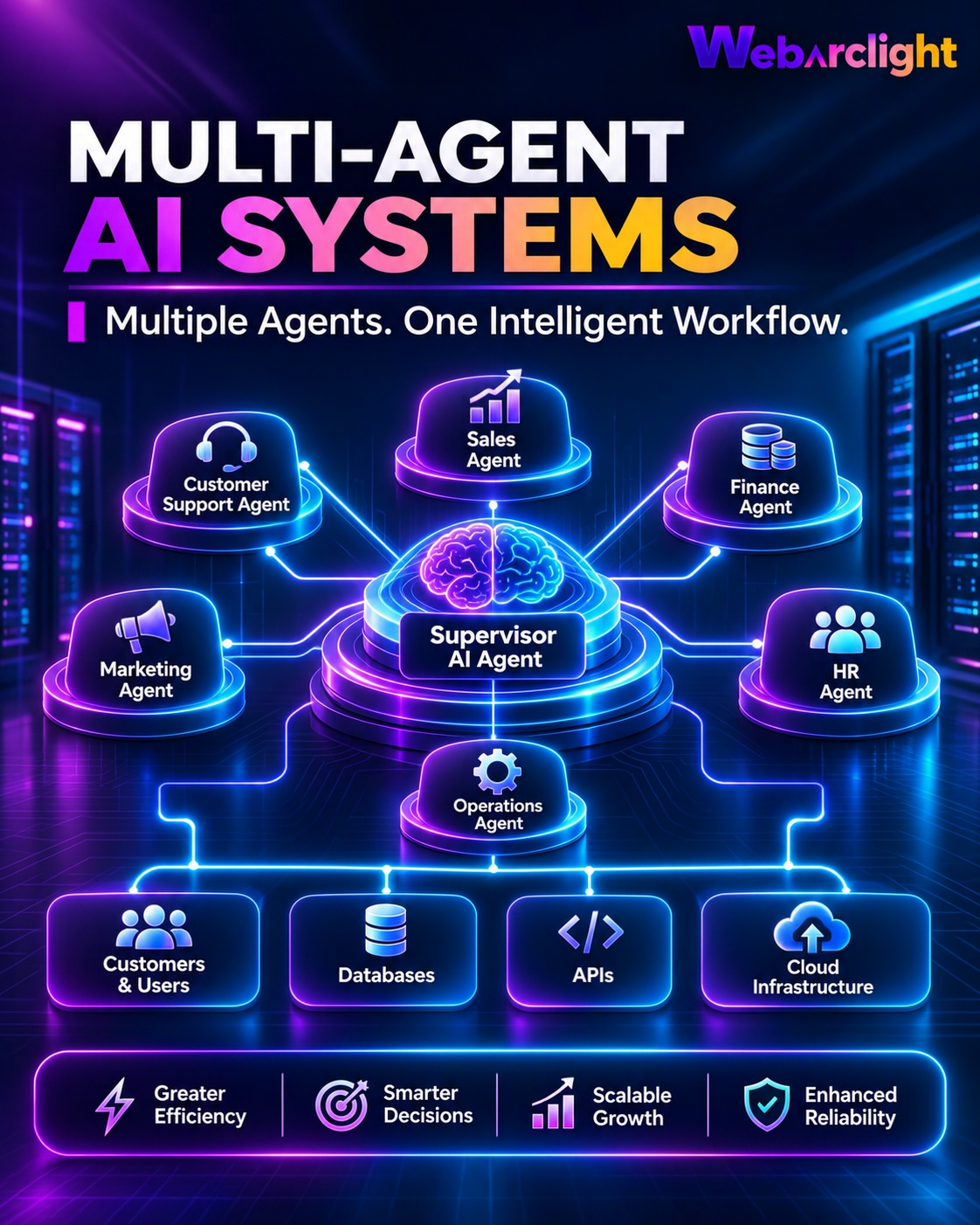
Artificial intelligence is moving beyond individual chatbots and AI assistants. Businesses are now exploring systems where multiple AI agents work together to complete complex tasks, share information, and automate entire workflows.
Imagine a business process where one AI agent understands a customer request, another retrieves customer information, a third checks inventory, and another prepares a response.
Instead of relying on one AI system to handle everything, multiple specialized agents collaborate to complete the task.
This approach is known as a Multi-Agent System (MAS).
As businesses explore agentic AI in 2026 and prepare for 2027, multi-agent systems are becoming an important area of enterprise automation.
Let's understand how they work, where businesses can use them, and what organizations should consider before adopting them.
What Is a Multi-Agent System?
A multi-agent system is an architecture in which multiple AI agents work together to achieve a shared objective.
Each agent can have a specific responsibility, access to selected tools, and instructions designed for a particular task.
For example, an organization could build a customer-support system with:
A customer-service agent that understands requests
An order-management agent that retrieves order information
A product agent that checks product availability
A troubleshooting agent that searches technical documentation
A supervisor agent that coordinates the results
Each agent handles a specialized responsibility, while the overall system works towards completing the customer's request.
This approach allows businesses to divide complex workflows into smaller, manageable tasks.
1. How Multi-Agent Systems Work
Most multi-agent architectures include specialized agents and an orchestration mechanism that coordinates their activities.
A common approach uses a supervisor agent.
The supervisor receives a request, determines which agents are required, distributes tasks, and combines their results.
For example, consider a customer asking:
"Check my order status and recommend an alternative if the product is unavailable."
The system could follow this process:
The supervisor agent understands the customer's request.
The order agent retrieves the current order status.
The inventory agent checks product availability.
The recommendation agent identifies suitable alternatives.
The supervisor combines the results.
The customer receives a complete response.
This allows different agents to work on specialized parts of the same task.
Depending on the architecture, agents can operate sequentially, in parallel, or through more complex coordination patterns.
2. Single AI Agent vs Multi-Agent System
A single AI agent can be effective for simple tasks, but complex business workflows may require multiple specialized capabilities.
| Capability | Single AI Agent | Multi-Agent System |
|---|---|---|
| Task handling | One agent manages the task | Multiple agents share responsibilities |
| Specialization | One agent may handle several areas | Each agent can focus on a specific domain |
| Coordination | Limited internal delegation | Agents coordinate through an orchestration layer |
| Complex workflows | Can become difficult to manage | Can divide work into smaller tasks |
| Scalability | Depends on one agent's design | Individual agents can be updated or scaled separately |
| Management | Simpler architecture | Requires coordination and monitoring |
Multi-agent systems are not automatically better.
For simple tasks, one well-designed agent may be sufficient. Multiple agents become useful when a workflow benefits from specialized responsibilities, parallel processing, or separate access permissions.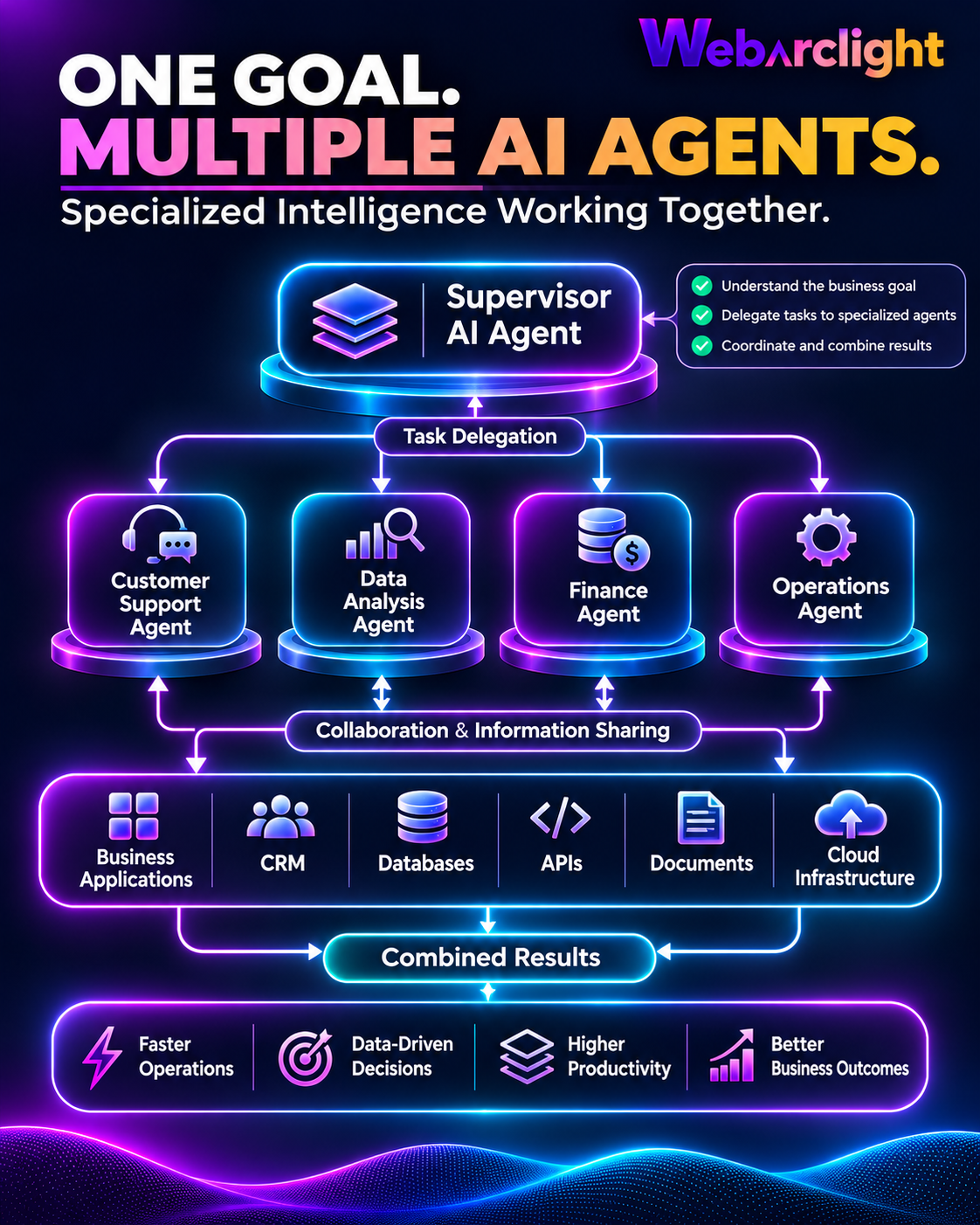
3. Multi-Agent Systems in Customer Support
Customer support is one of the practical applications of multi-agent automation.
A customer enquiry may require information from multiple systems, including order management, product databases, delivery services, and support documentation.
A multi-agent system can divide these responsibilities.
Customer Support Agent: Understands the customer's question.
Order Agent: Retrieves order and delivery information.
Product Agent: Checks availability and product details.
Knowledge Agent: Searches approved support documentation.
Supervisor Agent: Combines the information into a relevant response.
This can help businesses handle complex enquiries more efficiently while reducing repetitive work for support teams.
Sensitive account changes and other high-impact actions should still follow appropriate authorization and approval procedures.
4. Automating Sales and Marketing Operations
Sales and marketing teams work with large amounts of customer information, campaign data, and business communication.
Multi-agent systems can help organize these activities.
For example, a sales workflow could include:
A lead research agent that gathers approved business information
A qualification agent that evaluates lead requirements
A CRM agent that updates authorized records
A communication agent that prepares follow-up messages
A reporting agent that summarizes sales activity
Marketing teams can also use specialized agents for content research, campaign analysis, keyword research, and performance reporting.
Instead of performing every task independently, agents can coordinate their work through a common workflow.
Employees should review important external communications and business decisions before execution.
5. Multi-Agent Systems in Finance and HR
Finance and human resources departments also contain workflows that involve multiple information sources.
In finance, specialized agents could assist with:
Invoice information extraction
Expense classification
Financial document summarization
Transaction analysis
Report preparation
For example, an invoice-processing workflow could use one agent to extract invoice information, another to verify purchase-order details, and a third to prepare an exception report.
In HR, agents could support:
Employee onboarding
Policy information retrieval
Recruitment document organization
Employee enquiry management
HR reporting
A policy assistant could retrieve relevant information while another agent prepares a response for an employee.
However, payroll modifications, financial approvals, recruitment decisions, and sensitive employee-record changes should remain subject to appropriate human oversight.
6. Multi-Agent Systems for Software Development and IT Operations
Software development and IT operations involve multiple interconnected activities.
Multi-agent systems can help organize tasks across different technical responsibilities.
For example, a software development workflow might include:
Planning Agent: Understands requirements and prepares task summaries.
Coding Agent: Assists with generating or modifying code.
Testing Agent: Runs tests and identifies potential failures.
Review Agent: Examines code changes and reports issues.
Documentation Agent: Prepares technical documentation.
These agents can coordinate their work through an orchestration system.
In IT operations, specialized agents could help investigate alerts, summarize logs, identify infrastructure issues, and recommend corrective actions.
Production changes should still use controlled deployment procedures and authorized approvals.
7. The Technology Behind Multi-Agent Systems
Building a multi-agent system requires more than connecting several AI models.
Different components work together to support communication, task execution, and coordination.
Foundation Models: Provide reasoning, language understanding, and task-planning capabilities.
Agent Orchestration: Determines which agents should handle individual tasks and coordinates their results.
APIs and Tools: Allow agents to interact with business applications, databases, and external services.
Memory and Context: Help agents maintain relevant information during workflows.
Communication Protocols: Support structured interaction between agents and tools.
Monitoring and Security: Track agent activities, enforce permissions, and help identify unexpected behaviour.
Technologies and frameworks such as Amazon Bedrock AgentCore, Strands Agents, and agent communication approaches such as MCP and A2A can support different parts of multi-agent architectures.
The appropriate technology depends on the application's complexity, infrastructure, and integration requirements.
8. Why AWS Matters for Multi-Agent Applications
Cloud infrastructure plays an important role when multiple AI agents need to communicate, access tools, and process requests.
AWS provides services that can support different components of a multi-agent architecture.
For example:
Amazon Bedrock: Provides access to supported foundation models.
Amazon Bedrock AgentCore: Helps developers deploy, operate, and manage AI agents.
AWS Lambda: Executes application functions and tool operations.
Amazon S3: Stores documents and application data.
Amazon DynamoDB: Stores application state and other structured information.
Amazon EventBridge: Supports event-driven communication.
AWS Step Functions: Coordinates complex workflows.
Amazon CloudWatch: Supports monitoring and operational visibility.
AWS has also published guidance for multi-agent orchestration using a supervisor agent and specialized sub-agents.
This demonstrates how businesses can build systems in which different agents handle tasks such as order management, product recommendations, personalization, and technical support.
The architecture should be selected according to actual business requirements rather than using every available service.
9. Challenges of Multi-Agent Systems
Although multi-agent systems offer flexibility, they also introduce additional technical and operational challenges.
Coordination complexity: Multiple agents need clear responsibilities and reliable communication.
Data consistency: Agents must work with accurate and relevant information.
Higher operating costs: Multiple agents may require additional model calls, tool executions, and infrastructure resources.
Response latency: Complex workflows can take longer when several agents must complete tasks sequentially.
Security risks: Each agent and integration creates additional access and security considerations.
Debugging difficulties: Identifying the cause of an incorrect result can become harder when several agents are involved.
Businesses should carefully evaluate these challenges before deploying multi-agent applications in production.
10. Security and Governance in Multi-Agent Systems
When multiple AI agents collaborate, security becomes more complex.
An agent may delegate work to another agent, which may then access a database or business application.
Organizations need to maintain visibility and control across the complete workflow.
Important controls include:
Assigning each agent a defined identity
Applying least-privilege permissions
Verifying access at service boundaries
Protecting shared information and memory
Monitoring agent-to-agent communication
Maintaining execution logs and audit trails
Restricting sensitive operations
Requiring human approval for high-impact actions
For example, a sales agent should not automatically receive access to financial or HR records simply because it is part of the same multi-agent system.
Each agent should only access the information required for its assigned responsibility.
11. How Businesses Can Start With Multi-Agent AI
Organizations do not need to begin with a large network of autonomous agents.
A practical implementation can start with a clearly defined business process.
Step 1: Identify the workflow
Find a process involving multiple tasks or information sources.
Step 2: Divide responsibilities
Identify which tasks can be handled by specialized agents and which should remain with employees.
Step 3: Define the architecture
Choose an orchestration approach and decide how agents will communicate.
Step 4: Connect approved tools and data
Integrate only the APIs, databases, and applications required for the workflow.
Step 5: Establish security controls
Define agent identities, permissions, monitoring, and approval requirements.
Step 6: Test the complete workflow
Evaluate accuracy, reliability, cost, and behaviour when individual agents fail.
Step 7: Expand gradually
Start with a controlled deployment and introduce additional agents only when they provide measurable value.
This approach helps businesses avoid unnecessary complexity while developing practical AI automation solutions.
The Future of Multi-Agent Systems in 2027
The next stage of business AI is likely to involve more connected and specialized AI agents.
Organizations are exploring architectures where agents collaborate across departments, applications, and cloud environments.
Several developments will be important:
More advanced agent orchestration
Standardized agent communication
Better integration with enterprise applications
Improved memory and context management
Stronger identity and access controls
Better monitoring and observability
Human-agent collaboration
As these systems become more capable, businesses will need to focus on reliability, governance, and clear responsibility between agents.
The objective should not be to create as many agents as possible. It should be to build systems where specialized agents work together to solve real business problems.
Conclusion
Multi-agent systems represent an important development in the evolution of business AI.
By dividing complex workflows into specialized responsibilities, organizations can build applications where multiple AI agents collaborate to retrieve information, use tools, analyze data, and complete tasks.
From customer support and sales to finance, HR, software development, and IT operations, multi-agent architectures create new opportunities for business automation.
However, successful implementation requires proper orchestration, reliable integrations, secure access, monitoring, and human oversight.
At WebArclight, we help businesses explore AI integration, intelligent automation, AWS cloud infrastructure, and custom software development to build practical digital solutions.
The future of business automation is not just one intelligent agent. It is multiple specialized agents working together towards a shared goal.
https://webarclight.com/
Comments
my blog post ... <a href="https://www.youtube.com/@USGADGETREND">us gadget trend</a>