Artificial intelligence is transforming how businesses access information, automate operations and interact with customers. Modern AI models can generate content, answer questions, analyse documents and support complex business workflows.
However, general-purpose AI models do not automatically understand an organisation's internal processes, products, policies or private business information.
For example, a company may want to build an AI assistant that answers questions about its internal documents, retrieves customer information or provides accurate responses based on its latest product catalogue.
Simply connecting a general AI model to a business application may not be enough.
Two important approaches can help address this challenge: Retrieval-Augmented Generation (RAG) and Fine-Tuning.
Both approaches improve how AI applications perform, but they work differently. Understanding their differences can help businesses choose the right architecture for their AI projects.
1. What Is Retrieval-Augmented Generation (RAG)?
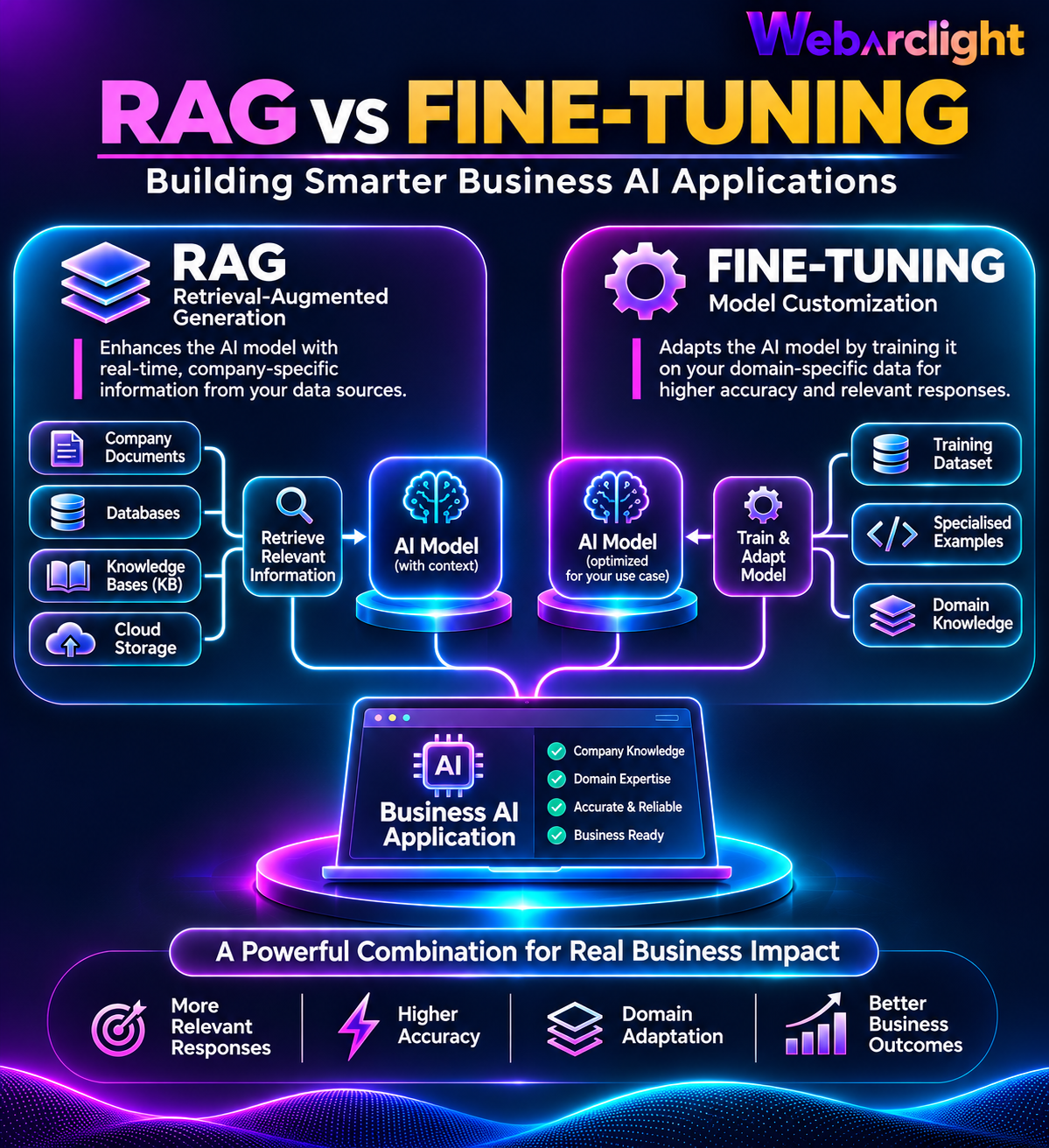
Retrieval-Augmented Generation, commonly known as RAG, is an approach that allows an AI model to retrieve relevant information from external knowledge sources before generating a response.
Instead of depending entirely on the information learned during model training, a RAG-based application searches a connected knowledge source and provides relevant information to the model as context.
This allows an AI application to answer questions using business-specific information without necessarily retraining the underlying model.
For example, imagine an organisation with thousands of internal documents, including employee policies, product manuals, technical documentation and customer support guidelines.
A RAG-powered assistant could retrieve relevant sections from these documents whenever an employee asks a question.
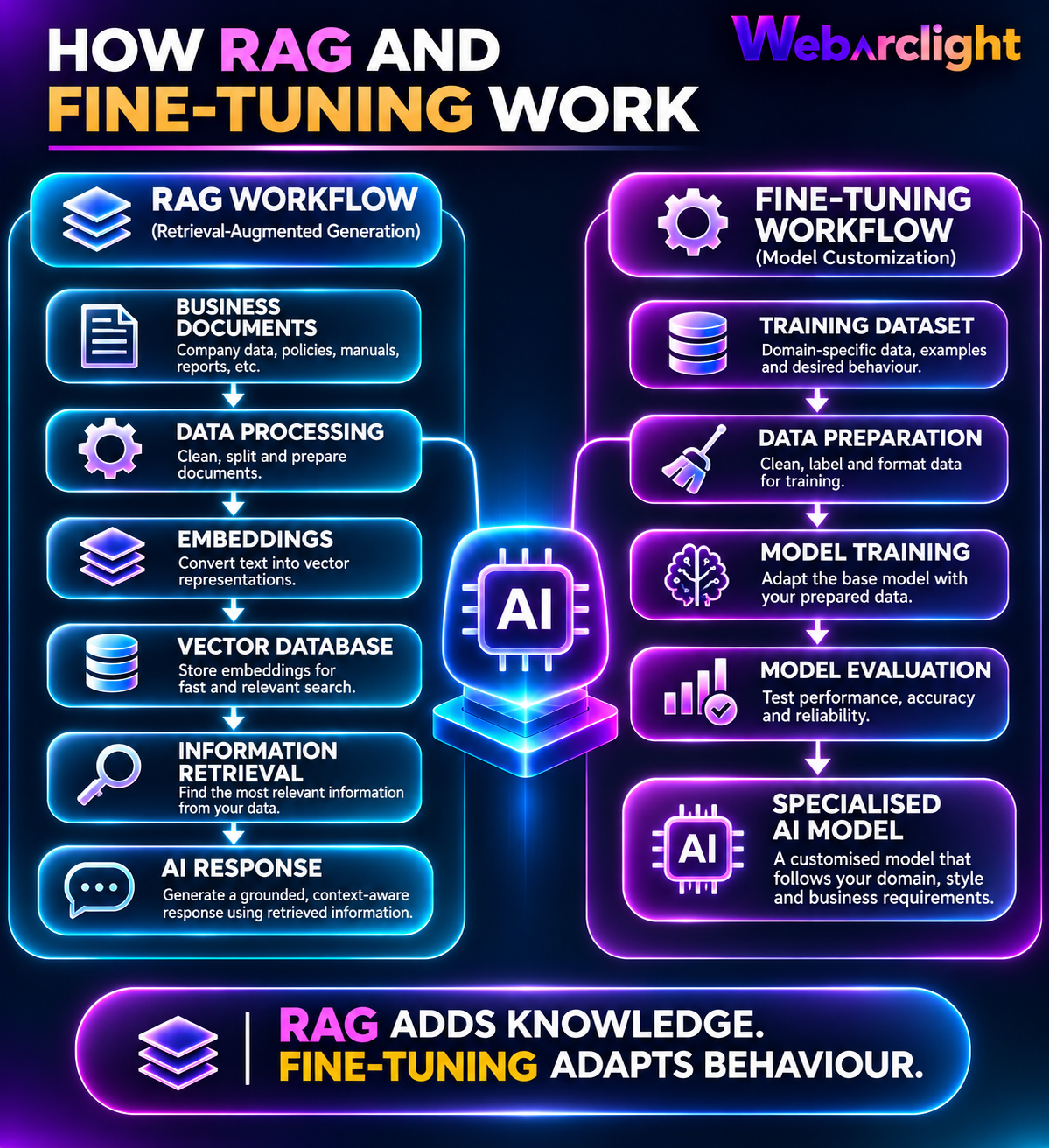
A typical RAG workflow includes:
1. Data collection: Gather relevant documents, reports and business information.
2. Data processing: Extract text, clean information and divide documents into smaller sections.
3. Embedding generation: Convert text sections into numerical representations called embeddings.
4. Information storage: Store embeddings and associated content in a searchable vector database or retrieval system.
5. User query: Receive a question from the user.
6. Information retrieval: Find relevant content based on the query.
7. Response generation: Provide the retrieved context to the AI model to generate an informed answer.
In simple terms, RAG allows an AI application to look up relevant information before answering a question.
2. What Is Fine-Tuning?
Fine-tuning is a process in which an existing AI model is further trained using a carefully prepared dataset to adapt its behaviour to a particular task or domain.
A general-purpose model may already understand language, reasoning patterns and common instructions. However, a business may need a model that follows a particular response format, understands specialised terminology or consistently performs a specific task.
Fine-tuning can help adapt the model to these requirements.
For example, a company providing technical support may have thousands of high-quality support conversations.
A suitable training dataset could help adapt a model to:
• Follow the company's preferred communication style.
• Classify support requests into specific categories.
• Produce structured responses.
• Recognise domain-specific terminology.
• Follow consistent task-specific instructions.
Fine-tuning generally involves preparing training examples, selecting a supported model, running the training process and evaluating the resulting model.
In simple terms, fine-tuning teaches an existing AI model to perform a task in a more specialised way.
3. RAG vs Fine-Tuning: What Is the Difference?
Although both techniques can improve AI applications, their objectives are different.
RAG focuses on providing relevant external information to the model, while fine-tuning focuses on adapting the model's behaviour through additional training.
Comparison RAG Fine-Tuning
Main purpose Provide external knowledge Adapt model behaviour
Approach Retrieve information during a query Further train an existing model
Business data Retrieved as context Included in a training dataset when appropriate
Updating information Update the knowledge source May require additional training
Best suited for Knowledge-based questions Specialised tasks and response patterns
Example Answering questions from company documents Classifying support requests consistently
Infrastructure Retrieval system and knowledge store Training pipeline and model evaluation
A useful way to remember the distinction:
• RAG helps an AI model access relevant information.
• Fine-tuning helps an AI model adapt to a specialised task or behaviour.
They are not direct replacements for each other. Depending on the business requirements, organisations can use either approach or combine both.
4. How RAG and Fine-Tuning Work in Real Business Applications
Consider an organisation building an AI-powered customer support platform.
The company wants an assistant that understands its communication style and provides accurate answers based on its latest product information.
RAG and fine-tuning can support different parts of this requirement.
Step 1: Understand the business requirements
The organisation identifies two objectives: consistent customer communication and accurate answers based on current product documentation.
Step 2: Use fine-tuning for specialised behaviour
A suitable model is fine-tuned using carefully prepared examples of customer support interactions so it can follow the desired response style and task format.
Step 3: Build a RAG knowledge base
Product manuals, FAQs, support documentation and approved company information are processed and indexed for retrieval.
Step 4: Retrieve relevant information
When a customer asks a question, the application searches its knowledge base for relevant information.
Step 5: Generate the response
The application provides the retrieved information and the customer's question to the model, which generates a response using the available context.
Step 6: Evaluate the results
The organisation checks whether the response is accurate, relevant, consistent and aligned with company policies.
This combination can help create an AI assistant that follows a consistent communication style while accessing relevant business information.
5. Why Should Businesses Consider RAG?
RAG can be particularly useful for organisations that need AI applications to work with private, specialised or frequently updated information.
Access to Business-Specific Knowledge
Businesses can connect AI applications to internal documents, product information, technical manuals and approved knowledge sources.
Easier Knowledge Updates
When business information changes, the organisation can update its knowledge source and retrieval index rather than necessarily retraining the underlying model.
More Contextual Responses
Providing relevant information alongside a user's question can help the model generate responses that are more closely related to the organisation's knowledge base.
Support for Internal AI Assistants
RAG can support applications such as employee assistants, technical support systems, document search platforms and internal knowledge management tools.
Improved Information Traceability
A well-designed RAG application can return references to retrieved documents or passages, allowing users to verify where information came from.
However, RAG does not guarantee factual accuracy. Poor-quality documents, incorrect retrieval results and incomplete context can still lead to unreliable responses.
6. When Should Businesses Choose Fine-Tuning?
Fine-tuning is useful when the main requirement is to change how a model performs a particular task rather than simply giving it access to additional information.
Businesses may consider fine-tuning when they need:
Consistent Output Formats
An organisation may require AI-generated responses in a specific structure, such as JSON, reports, classifications or standardised business documents.
Specialised Task Performance
Fine-tuning can help adapt a model for a particular classification, extraction, summarisation or domain-specific task.
Consistent Communication Style
Businesses may want their AI applications to follow a defined tone, terminology and response pattern.
Domain-Specific Behaviour
A carefully prepared dataset can help a model become more suitable for specialised workflows, depending on the model and training approach.
Fine-tuning also requires appropriate training data, evaluation and ongoing maintenance. It is not automatically the best solution for every business-specific AI requirement.
7. RAG and Fine-Tuning: Which Approach Is Right for Your Business?
The right choice depends on the problem an organisation is trying to solve.
Business requirement Recommended approach
Answer questions from internal documents RAG
Retrieve information from updated product catalogues RAG
Search company policies and manuals RAG
Follow a specialised response format Fine-tuning may help
Improve task-specific classification Fine-tuning may help
Maintain consistent domain-specific behaviour Fine-tuning may help
Combine business knowledge with specialised behaviour RAG + Fine-Tuning
Before choosing an approach, businesses should consider:
• Data availability: Is the information frequently updated or relatively stable?
• Accuracy requirements: Does the application need verifiable answers from specific sources?
• Task complexity: Is the challenge mainly retrieving knowledge or adapting model behaviour?
• Infrastructure: What retrieval, storage, training and deployment resources are required?
• Cost: What are the ongoing costs of model usage, data processing, retrieval and training?
• Maintenance: How frequently will the application and its knowledge sources need updates?
A proof of concept can help organisations compare approaches before investing in a larger AI system.
8. The Role of AWS in Building RAG and Fine-Tuned AI Applications
Cloud infrastructure can provide the resources needed to develop, deploy and scale AI applications.
Amazon Web Services (AWS) offers several services that can support different parts of these architectures.
For example:
• Amazon Bedrock: Provides access to foundation models and capabilities for building generative AI applications.
• Amazon Bedrock Knowledge Bases: Helps implement managed retrieval workflows using connected knowledge sources.
• Amazon S3: Can store documents and other source data.
• Amazon OpenSearch Service: Can support vector search and retrieval architectures.
• AWS Lambda: Can execute application logic and processing functions.
• Amazon SageMaker AI: Provides capabilities for developing, training, fine-tuning and deploying machine learning models.
• Amazon CloudWatch: Supports monitoring and operational visibility.
The appropriate combination depends on the application's architecture, data requirements, model choices and expected workload.
Businesses should also consider data permissions, encryption, monitoring and secure access controls when building these systems.
9. The Future of Business AI: RAG, Fine-Tuning and Beyond
The development of generative AI is creating new opportunities for organisations to build applications around their own knowledge and business processes.
RAG and fine-tuning are important approaches, but they are only parts of a broader AI development ecosystem.
Businesses are increasingly exploring architectures that combine retrieval systems, specialised AI models, intelligent agents, APIs and cloud infrastructure.
As AI applications evolve, organisations may use RAG to retrieve relevant information, fine-tuning to adapt model behaviour and AI agents to coordinate tasks across multiple business systems.
Models and platforms such as ChatGPT, Claude AI, AWS Bedrock and other enterprise AI solutions can support different parts of these architectures, depending on their capabilities and deployment requirements.
The focus is gradually moving from simply using AI models towards building complete AI-powered business applications.
Conclusion
RAG and fine-tuning solve different challenges in building business-specific AI applications.
RAG enables models to access relevant external information when generating responses, while fine-tuning adapts models to specialised tasks, behaviours and output requirements.
For businesses working with internal documents, frequently changing information and specialised workflows, choosing the right approach can significantly influence application performance, maintenance and cost.
Rather than adopting a technology simply because it is popular, organisations should first identify their business requirements and select an architecture that addresses the actual problem.
At WebArclight, we help businesses explore AI application development, cloud infrastructure and intelligent automation solutions that turn modern AI technologies into practical business capabilities. https://webarclight.com/
Comments
No Comments Yet
Be the first to share your thoughts!