
Healthcare organisations manage complex operations every day. From patient registration and appointment scheduling to medical documentation, billing, insurance verification and follow-up coordination, healthcare professionals handle a large volume of administrative work alongside patient care.
Many of these processes still involve manual data entry, repetitive communication and information transfer between disconnected systems.
Artificial intelligence is creating new opportunities to improve these workflows.
AI agents can help healthcare organisations retrieve information, coordinate tasks, interact with business applications and automate repetitive administrative processes. Instead of functioning only as chatbots that answer questions, these systems can work across multiple steps to complete specific tasks under defined permissions.
For example, an AI-powered healthcare assistant could collect patient registration details, identify missing information, prepare appointment records and notify the appropriate staff member.
As healthcare technology continues to evolve, AI agents in healthcare are becoming an important area of exploration for organisations looking to improve operational efficiency and digital patient experiences.
1. What Are AI Agents in Healthcare?
AI agents in healthcare are software systems that use artificial intelligence to understand requests, retrieve information, interact with connected applications and perform assigned tasks within a healthcare workflow.
Unlike traditional automation, which generally follows predefined rules, AI agents can interpret information and determine which approved actions are needed to complete a task.
Depending on their design and permissions, healthcare AI agents can support activities such as:
• Collecting and organising patient registration information.
• Scheduling appointments and managing reminders.
• Retrieving relevant information from authorised records.
• Preparing medical documentation for professional review.
• Organising insurance and billing information.
• Tracking laboratory report and diagnostic workflows.
• Coordinating patient follow-ups.
• Answering routine administrative questions.
For example, when a patient requests an appointment, an AI agent could identify the requested department, check available appointment slots, collect required details and prepare the booking for confirmation.
The agent does not need to make clinical decisions to provide operational value.
In simple terms, AI agents help healthcare organisations coordinate information and complete repetitive tasks through intelligent automation.
2. How Do AI Agents Work in Healthcare Systems?
Healthcare AI agents generally operate through a combination of AI models, connected applications, data retrieval systems and workflow automation.
A typical architecture includes several components.
Step 1: Patient or Staff Request
The process begins when a patient or healthcare employee submits a request through a website, mobile application, patient portal or internal system.
For example, a patient may request an appointment or ask about an upcoming consultation.
Step 2: Request Understanding
The AI agent analyses the request and identifies the information or action required.
It may determine whether the request relates to appointment scheduling, patient registration, billing, documentation or another administrative process.
Step 3: Information Retrieval
The agent retrieves relevant information from authorised healthcare systems.
Depending on permissions, this may include appointment availability, patient registration details, administrative policies or approved records.
Step 4: Task Execution
The agent interacts with connected applications through approved APIs, tools or workflow integrations.
It may prepare an appointment request, update a permitted record or create a follow-up task.
Step 5: Validation and Approval
The system checks whether the required information is available and whether the requested action is permitted.
Actions involving sensitive information or important operational decisions may require staff approval.
Step 6: Completion and Notification
After the task is completed or approved, the system updates the relevant workflow and provides a notification or confirmation.
This architecture allows healthcare organisations to connect multiple administrative activities into a more coordinated process.
3. Major Applications of AI Agents in Healthcare
AI agents can support different areas of healthcare operations. Their role depends on the organisation's requirements, available infrastructure and the level of human supervision.
Patient Registration and Onboarding
Patient registration often requires collecting personal details, contact information, appointment preferences and supporting documents.
An AI agent can help:
• Collect registration information.
• Identify missing fields.
• Organise uploaded documents.
• Check information against approved records.
• Route incomplete registrations to reception staff.
• Prepare registration records for confirmation.
This can reduce repetitive data entry and help reception teams manage incoming registrations more efficiently.
Appointment Scheduling and Management
Appointment management involves coordinating patients, doctors, departments and available time slots.
AI agents can assist with:
• Identifying suitable appointment categories.
• Checking available schedules.
• Processing appointment requests.
• Sending reminders and confirmations.
• Managing cancellation requests.
• Coordinating rescheduling workflows.
For example, an appointment assistant could receive a request, identify the relevant department and present available time slots for patient confirmation.
Medical Documentation and Record Summarisation
Healthcare professionals work with clinical notes, medical histories, laboratory reports and other records.
AI systems can help organise and summarise information to reduce documentation effort.
Possible applications include:
• Preparing draft consultation notes.
• Summarising relevant patient history.
• Organising information from previous visits.
• Extracting structured details from documents.
• Preparing documentation for professional review.
AI-generated clinical documentation should be checked by qualified healthcare professionals before it is finalised.
Laboratory and Diagnostic Workflow Coordination
Laboratory operations involve multiple steps, including test requests, sample collection, report preparation and result delivery.
AI agents can support administrative coordination by:
• Tracking pending laboratory requests.
• Identifying missing documentation.
• Organising uploaded reports.
• Notifying authorised staff when reports are available.
• Routing flagged results for appropriate review.
• Tracking report status across departments.
Such systems can improve workflow visibility without independently interpreting diagnostic findings or replacing professional review.
Insurance and Billing Administration
Healthcare billing and insurance processes often require collecting documents, checking information and coordinating approvals.
AI agents can assist with:
• Organising insurance documents.
• Extracting information from claim forms.
• Identifying missing fields.
• Preparing prior authorization documentation.
• Tracking claim status.
• Routing billing queries to the appropriate team.
These capabilities can help reduce repetitive administrative work and improve process coordination.
Patient Follow-Ups and Communication
Healthcare organisations frequently need to communicate appointment reminders, administrative instructions and follow-up information.
AI agents can help coordinate approved communication workflows, such as:
• Sending appointment reminders.
• Notifying patients about registration requirements.
• Sharing approved administrative instructions.
• Coordinating follow-up scheduling.
• Routing patient queries to the appropriate department.
Sensitive or clinically significant communications should follow approved clinical protocols and appropriate staff oversight.
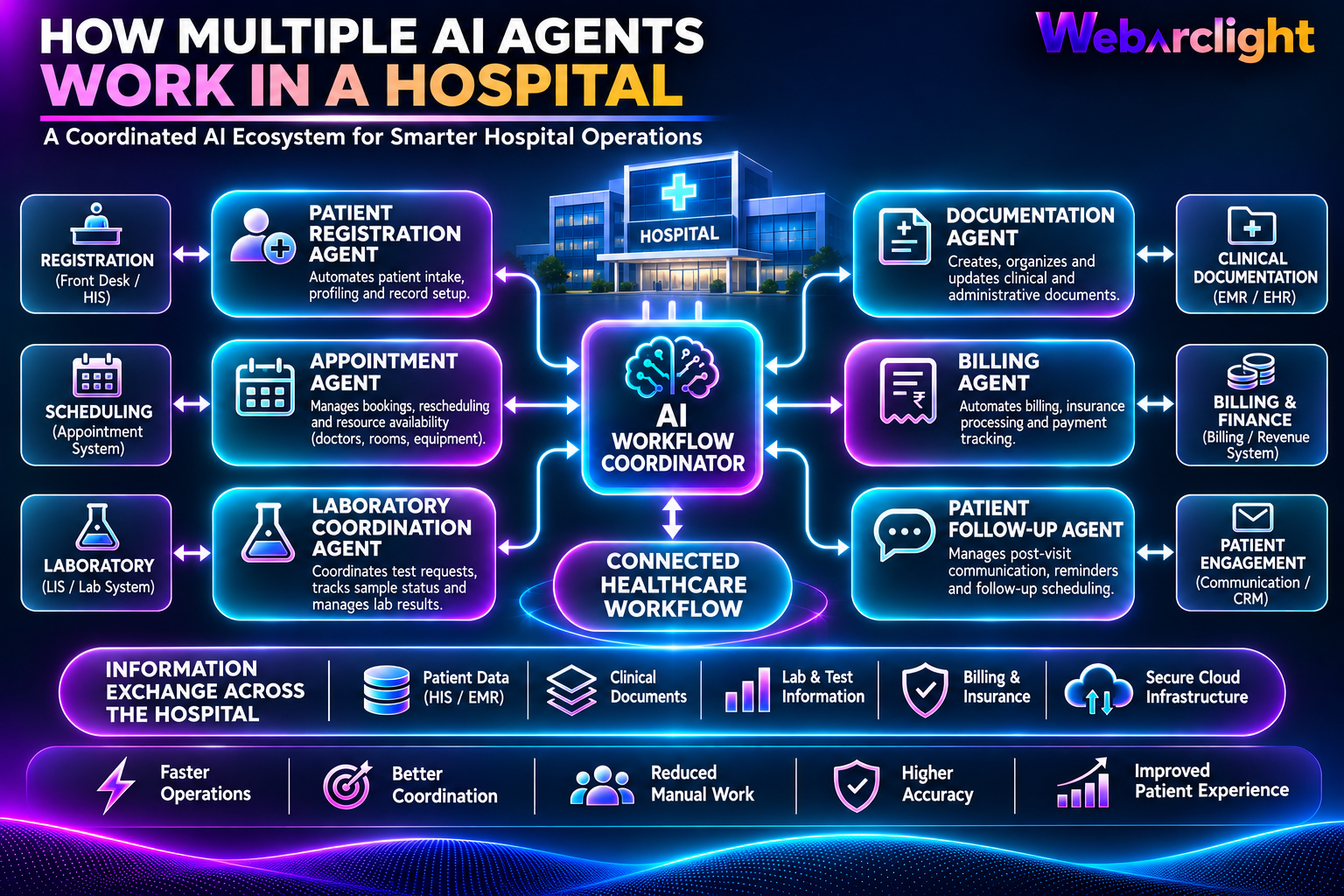
4. How Multiple AI Agents Can Work Together in a Hospital
A hospital or multi-specialty clinic may have different departments handling registration, appointments, billing, laboratory services and medical documentation.
A multi-agent architecture can assign specific responsibilities to different agents while coordinating their activities through a central workflow.
Consider a patient visiting a hospital for a scheduled consultation.
Step 1: Registration Agent
The registration agent collects patient details, identifies missing information and prepares the registration record.
Step 2: Appointment Agent
The appointment agent retrieves available schedules and coordinates the requested appointment with the relevant department.
Step 3: Documentation Agent
The documentation agent organises available records and prepares relevant information for staff review.
Step 4: Billing Agent
The billing agent retrieves authorised billing information and helps organise payment or insurance documentation.
Step 5: Laboratory Coordination Agent
If a laboratory request is created, this agent tracks the administrative status of the request and coordinates report availability.
Step 6: Follow-Up Agent
After the consultation, the follow-up agent can help schedule the next appointment or send approved administrative reminders.
Each agent performs a defined responsibility, while the overall workflow coordinates the patient journey.
This approach can help reduce information gaps between departments and improve operational visibility.
5. AI Agents vs Traditional Healthcare Automation
Traditional healthcare automation typically depends on predefined rules and structured workflows.
AI agents can interpret requests, work with different information sources and coordinate multiple approved actions.
Comparison Traditional Automation AI Agents
Task execution Predefined rules Context-based task planning
Information handling Structured inputs Can process varied information
Workflow coordination Fixed workflows Can coordinate multiple tasks
Application integration Rule-based connections Tool and API-based interactions
Adaptability Changes require rule updates Can interpret different requests within defined limits
Human involvement Depends on workflow design Can request review or approval
Example Send an appointment reminder Understand an appointment request and coordinate booking
AI agents do not automatically make every workflow faster or more reliable. Their performance depends on the quality of connected systems, permissions, validation and monitoring.
Traditional automation can remain the better choice for simple, predictable tasks. AI agents are more relevant when a workflow requires interpretation or coordination across multiple systems.
6. The Role of Healthcare Data Integration
One of the major challenges in healthcare technology is that information is often distributed across different applications.
A hospital may use separate systems for:
• Electronic Health Records (EHR).
• Hospital Information Systems (HIS).
• Laboratory Information Management Systems (LIS).
• Pharmacy management.
• Billing and insurance.
• Appointment scheduling.
• Patient portals.
AI agents need controlled access to the relevant information to coordinate activities across these systems.
Technologies and standards such as healthcare APIs and HL7 FHIR can help support structured data exchange between compatible healthcare applications.
For example, an authorised AI agent could retrieve appointment information from a scheduling system, access permitted patient records through an integration layer and prepare a task for the relevant department.
The integration architecture should ensure that data access is permission-based, traceable and consistent with applicable healthcare requirements.
7. The Role of AWS in Building Healthcare AI Applications
Cloud infrastructure provides the computing, storage, integration and AI capabilities required to develop healthcare applications.
Amazon Web Services (AWS) offers services that can support different components of healthcare AI architectures.
• Amazon Bedrock: Provides access to foundation models for building generative AI applications and agent-based workflows.
• Amazon Bedrock AgentCore: Provides infrastructure and capabilities for deploying and operating AI agents.
• AWS HealthLake: Supports the storage, transformation and analysis of healthcare data using the FHIR standard.
• Amazon S3: Provides storage for documents, reports and other application data.
• AWS Lambda: Supports event-driven processing and application logic.
• AWS Step Functions: Helps coordinate multi-step workflows.
• Amazon CloudWatch: Provides monitoring and logging capabilities.
For example, a healthcare organisation could build a document processing workflow that receives an uploaded report, extracts relevant information, validates the output and routes it to an authorised staff member.
AI agents can coordinate parts of this workflow while cloud services provide the underlying infrastructure.
The final architecture must be designed around applicable privacy requirements, data residency needs, security controls and the healthcare organisation's operational policies.
8. Security, Privacy and Ethical Considerations
Healthcare applications handle highly sensitive information, making security and responsible AI implementation essential.
An AI agent that accesses patient records or interacts with clinical systems must operate under strict permissions and oversight.
Important safeguards include:
Patient Data Privacy
Protect personal and health information through appropriate encryption, access restrictions and secure data handling.
Role-Based Access Control
Ensure that each agent can access only the information required for its assigned responsibilities.
Human Oversight
Clinical decisions, treatment recommendations and other high-impact activities must remain under appropriate professional oversight.
Data Accuracy and Validation
Validate extracted information and AI-generated summaries against authorised source records.
Audit Trails
Maintain records of data access, agent actions, approvals and changes made to connected systems.
Secure Integrations
Protect APIs, healthcare databases and external services through authentication, authorization and monitoring.
Bias and Fairness
Evaluate AI systems for performance differences across relevant patient groups and operational settings.
Regulatory Compliance
Healthcare organisations must assess applicable privacy, security and healthcare regulations in the jurisdictions where their systems operate.
The World Health Organization emphasises the importance of human rights, accountability, transparency and ethical oversight when AI is used in health-related applications.
AI should support healthcare professionals rather than replace their judgement.
9. How Healthcare Organisations Can Start Adopting AI Agents
Healthcare organisations can begin with administrative use cases that have clearly defined processes and measurable outcomes.
A practical implementation approach includes:
1. Identify repetitive tasks: Evaluate activities such as appointment coordination, registration, document management and administrative communication.
2. Select a suitable workflow: Start with a process that has clear inputs, outputs and approval requirements.
3. Define agent responsibilities: Specify what the agent can access, what it can perform and which actions require human approval.
4. Connect existing systems: Integrate relevant EHR, HIS, scheduling, billing or document management applications through secure interfaces.
5. Establish security controls: Implement authentication, role-based permissions, data protection and audit logging.
6. Test with controlled workflows: Evaluate accuracy, reliability, usability and failure handling before wider deployment.
7. Measure operational performance: Track processing time, administrative workload, error rates and staff feedback.
8. Expand gradually: Introduce additional agents only after the initial workflow demonstrates reliable performance.
Starting with administrative automation can help organisations build experience before exploring more complex clinical support applications.
10. The Future of AI Agents in Healthcare
Healthcare AI is moving beyond individual assistants towards connected systems that can coordinate activities across departments and applications.
As agentic AI develops, organisations may increasingly explore:
• Coordinated multi-agent hospital workflows.
• Automated administrative documentation.
• More connected patient registration and scheduling.
• Intelligent medical document organisation.
• Improved insurance and claims coordination.
• Integration with healthcare data standards.
• AI-assisted operational monitoring.
• Secure coordination between healthcare applications.
Recent developments from technology providers demonstrate growing interest in agentic healthcare workflows, including clinical documentation, patient record preparation and administrative coordination.
However, wider adoption will depend on reliable integration, clinical validation, privacy safeguards and appropriate human oversight.
The opportunity is not to replace healthcare professionals with autonomous systems. It is to reduce repetitive administrative work and help healthcare teams spend more time on activities that require human expertise.
Conclusion
AI agents are creating new opportunities for healthcare organisations to improve patient administration, coordinate departments and automate repetitive workflows.
From registration and appointment scheduling to document management, billing and laboratory coordination, intelligent agents can help connect different parts of healthcare operations.
Successful implementation requires more than advanced AI models. Secure integrations, accurate information, defined permissions, regulatory compliance and human oversight must remain central to the architecture.
As healthcare organisations continue their digital transformation, AI agents can become valuable tools for building more connected, efficient and responsive healthcare systems.
At WebArclight, we help businesses explore AI application development, cloud infrastructure and intelligent automation solutions that support practical digital transformation across industries, including healthcare.
https://webarclight.com/
Comments
No Comments Yet
Be the first to share your thoughts!