
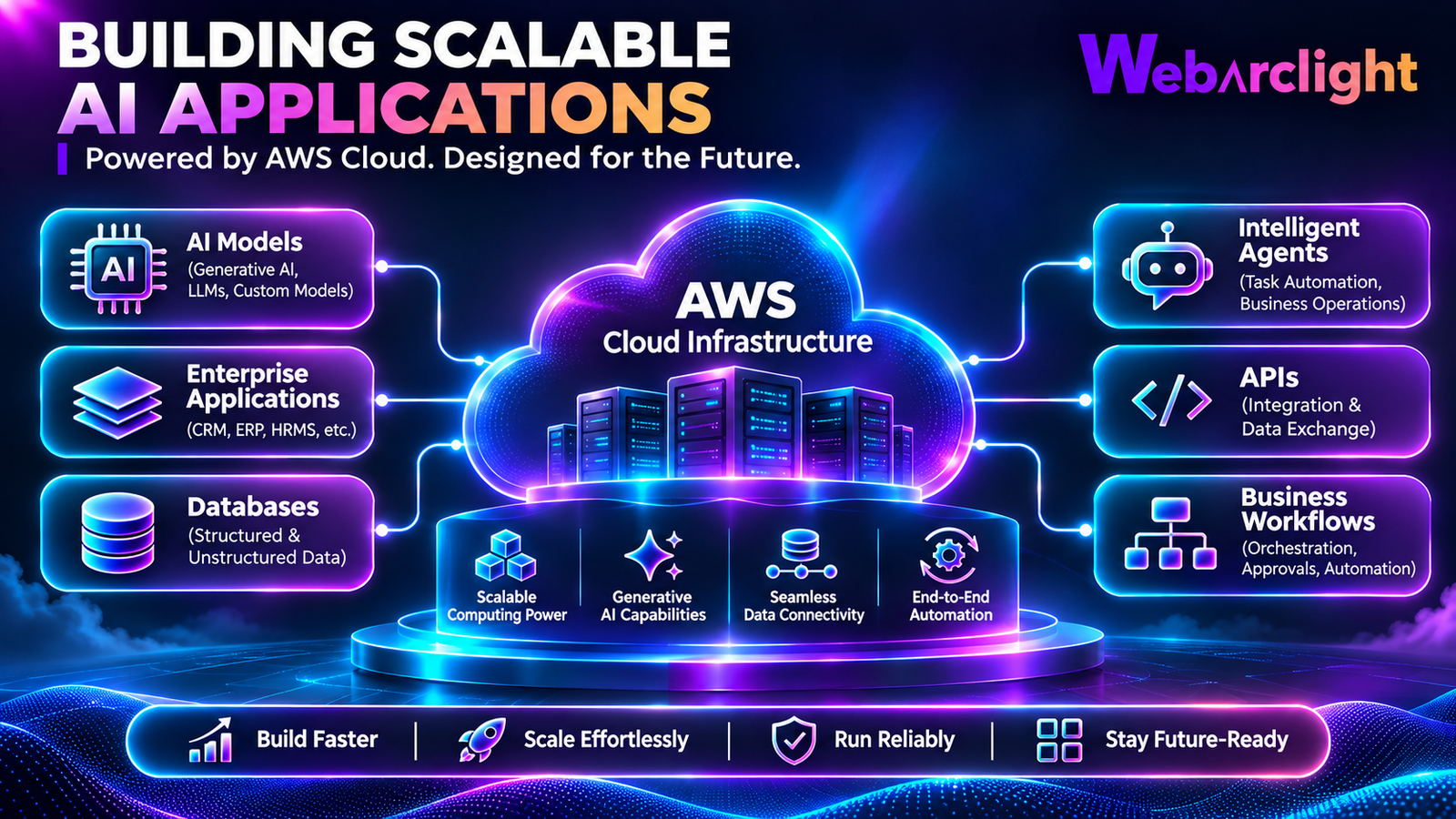
Artificial intelligence is changing how businesses build and operate digital applications. From AI-powered customer support to intelligent business assistants and automated workflows, organizations are increasingly integrating AI into their products and services.
Tools such as ChatGPT and Claude AI have made generative AI more accessible. However, building a production-ready AI application requires more than choosing a powerful GPT or Claude model.
Businesses also need reliable cloud infrastructure, secure data access, application integrations, performance monitoring, and the ability to handle growing demand.
This is where AWS cloud infrastructure becomes valuable.
Amazon Web Services provides a range of cloud services that businesses can combine to develop, deploy, and scale modern AI applications.
Let's explore how organizations can build scalable AI applications with AWS in 2026 and prepare for the next generation of AI technology in 2027.
1. Why Businesses Need Scalable AI Applications
An AI application may initially serve a small number of users. However, as more customers and employees begin using it, the application must handle increasing requests and workloads.
For example, an AI customer-support application may initially process a few hundred requests daily. As the business grows, it may need to support thousands of conversations, retrieve information from multiple databases, and connect with additional business systems.
A scalable AI application should be able to:
Handle increasing user requests
Manage changing workloads
Maintain acceptable response times
Connect with business applications
Process large amounts of information
Protect sensitive business data
Manage infrastructure and operating costs
Without suitable architecture, an AI application may become expensive, slow, or difficult to maintain as usage increases.
2. Using AWS to Build AI Applications
AWS provides cloud infrastructure and managed services that developers can combine to build AI-powered applications.
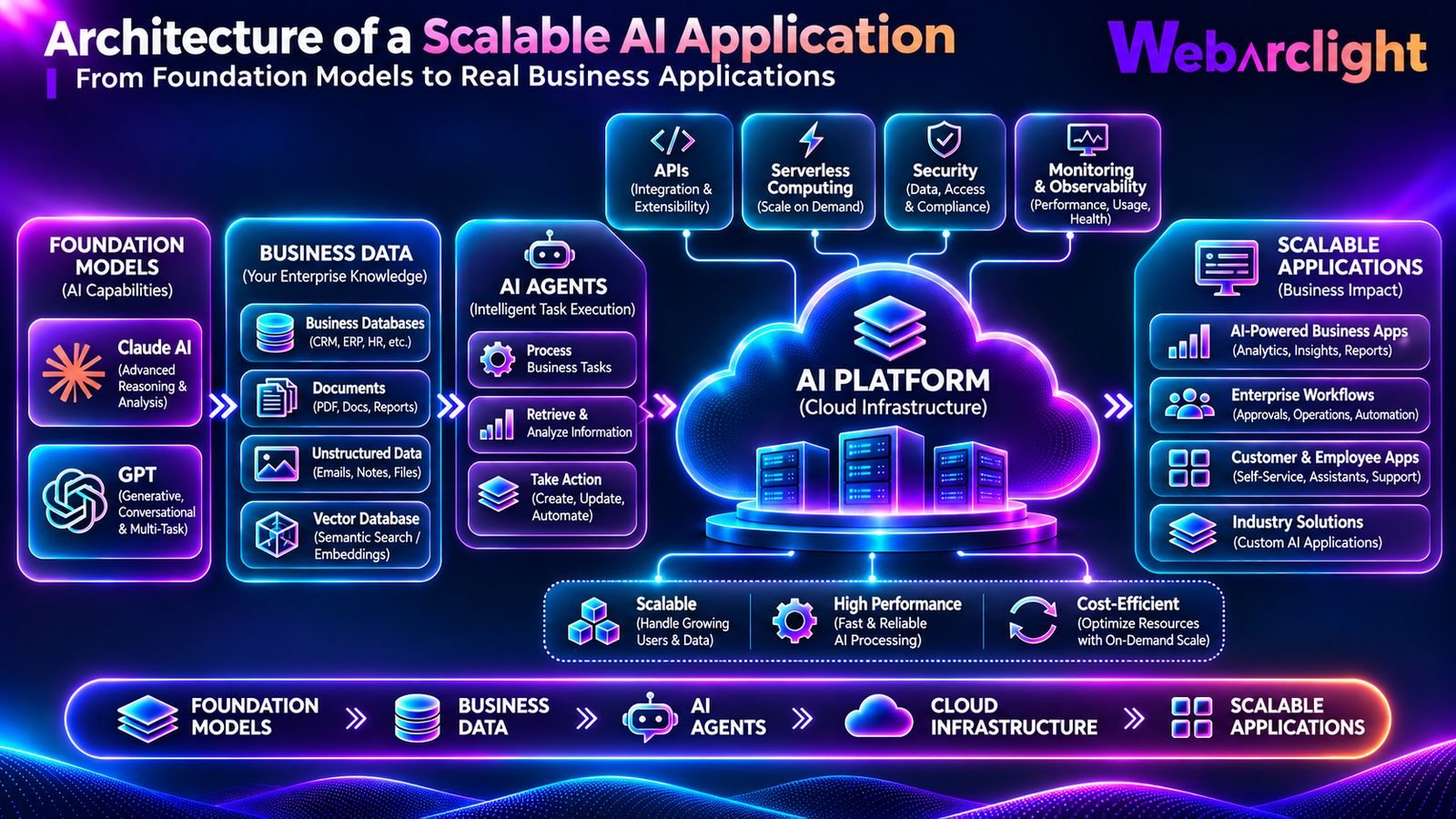
A typical architecture may include:
Amazon Bedrock: Access foundation models and develop generative AI applications.
AWS Lambda: Execute application logic without managing servers.
Amazon API Gateway: Create and manage application APIs.
Amazon S3: Store documents, files, and application data.
Amazon RDS: Manage relational databases.
Amazon CloudWatch: Monitor application performance and activity.
These services can work together to create applications that connect AI capabilities with business data and existing software systems.
For example, a business could build an AI assistant that receives a customer request, retrieves relevant information from a database, uses a foundation model to prepare a response, and returns the result through a web application.
The architecture can be expanded as the application's requirements grow.
3. Choosing the Right AI Model: Claude, ChatGPT, and GPT
One important decision when developing an AI application is selecting the appropriate foundation model.
Different models offer different capabilities, performance characteristics, integration options, and pricing structures.
Some widely discussed AI technologies include:
Claude AI: Developed by Anthropic, Claude offers capabilities for conversational applications, document analysis, coding assistance, and other generative AI tasks.
ChatGPT and GPT models: OpenAI's ChatGPT is a conversational AI product, while GPT models are available through developer APIs and supported cloud integrations. They can be used to build assistants, content applications, coding tools, and other AI-powered solutions.
Amazon Bedrock foundation models: Amazon Bedrock provides access to multiple foundation models through managed AWS services, subject to model and regional availability.
Businesses should not select a model only because it is popular.
They should evaluate:
Accuracy for the intended task
Response speed and latency
Cost per request
Context and input requirements
Tool and API integration capabilities
Data protection requirements
Model availability
Scalability
For example, a document-analysis application may require a model that handles long documents effectively, while a customer-support application may prioritize response speed and cost.
The best model is the one that meets the application's actual requirements.
4. Building AI Applications With Amazon Bedrock
Amazon Bedrock helps developers build generative AI applications without independently managing the underlying infrastructure for every foundation model.
It provides managed access to supported models and capabilities for developing AI-powered systems.
Businesses can use Amazon Bedrock to create:
AI-powered business assistants
Intelligent document-processing applications
Customer-support solutions
Enterprise knowledge assistants
AI-powered search systems
Generative AI applications
AI-agent workflows
For example, an organization could develop an internal knowledge assistant that answers employee questions using approved company documents.
Using Amazon Bedrock Knowledge Bases, developers can connect business information to generative AI applications through retrieval-augmented generation (RAG).
This allows the application to retrieve relevant information before generating an answer.
It is particularly useful when an AI application needs to work with company-specific information rather than relying only on general model knowledge.
5. Moving From AI Models to AI Agents
The next generation of AI applications is moving beyond simple question-and-answer interactions.
AI agents can understand goals, use tools, access approved information, and complete multiple steps within a workflow.
For example, an AI-powered business application could receive a request to prepare a customer report.
An agent might:
Understand the reporting requirements.
Retrieve relevant customer information.
Access authorized business databases.
Analyze the available information.
Prepare a structured report.
Request human approval where necessary.
Deliver the completed report.
AWS provides services and capabilities such as Amazon Bedrock AgentCore to support the development and operation of AI agents.
As organizations adopt agentic AI, scalable infrastructure becomes increasingly important because agents may perform multiple model calls, use external tools, and execute longer workflows.
Businesses should also monitor agent activity, token consumption, permissions, and operating costs.
6. Connecting AI Applications With Business Data
An AI application becomes more useful when it can access the information required to complete its tasks.
Businesses store information across different systems, including:
Customer relationship management platforms
Enterprise databases
Document management systems
Internal applications
Cloud storage
Business reporting tools
AWS services can help developers connect these systems with AI applications.
For example, Amazon S3 can store business documents, databases can provide structured information, and APIs can connect existing applications with AI-powered services.
Retrieval-Augmented Generation can help applications retrieve relevant information from approved data sources before generating responses.
However, organizations must implement appropriate data-access permissions, encryption, and information-protection controls.
An AI application should only retrieve information that its authorized users and workflows are permitted to access.
7. Designing Cloud Infrastructure for AI Workloads
AI applications can have different infrastructure requirements depending on their functionality.
A basic AI assistant may primarily use API-based model access, while an advanced AI application may require document processing, databases, background jobs, event-driven workflows, and additional computing resources.
A scalable AWS architecture can combine several services.
For example:
AWS Lambda for event-driven application logic
Amazon API Gateway for managing API requests
Amazon S3 for file storage
Amazon SQS for managing asynchronous workloads
Amazon Bedrock for generative AI capabilities
Amazon CloudWatch for monitoring
This allows developers to create modular applications where different components perform specific responsibilities.
As the application grows, individual components can be optimized without necessarily rebuilding the entire system.
8. Security and Governance for Enterprise AI
Security is one of the most important considerations when deploying AI applications for business use.
An enterprise AI application may process customer information, internal documents, financial records, and other sensitive data.
Businesses should establish appropriate controls around:
Identity and access management: Ensure users and services can access only the resources required for their tasks.
Data protection: Protect sensitive information through encryption and appropriate data-handling policies.
API security: Authenticate requests and control communication between application components.
AI safeguards: Apply suitable protections to model inputs and outputs.
Monitoring: Track application activity, failures, and unusual behaviour.
Agent governance: Define what AI agents can access and which actions require human approval.
AWS provides services and capabilities that can support these requirements, but businesses must configure and manage their architecture appropriately.
Security should be considered during application design rather than added only after deployment.
9. Managing AI Application Performance and Costs
Scaling an AI application is not simply about adding more infrastructure.
Organizations must also understand how their applications consume computing resources and foundation-model capacity.
AI application costs may depend on:
Number of model requests
Input and output token consumption
Selected foundation model
Data-processing requirements
Infrastructure usage
Storage requirements
API traffic
Monitoring and logging
For example, an AI agent that completes a multi-step task may make several model calls and interact with multiple tools.
This can increase costs compared with a simple question-and-answer interaction.
Businesses should monitor usage, optimize prompts, select suitable models, and establish spending limits or alerts where appropriate.
Amazon CloudWatch and AWS cost-management capabilities can help organizations monitor infrastructure and application usage.
The objective is to maintain the right balance between performance, reliability, and operating costs.
10. Preparing for AI Infrastructure Trends in 2027
As businesses move towards 2027, AI infrastructure is expected to become increasingly important.
Several areas deserve attention:
AI agents in production: Businesses will continue exploring agents that can execute complex workflows across enterprise systems.
AI-ready data infrastructure: Organizations will need better ways to organize, retrieve, and manage information used by AI applications.
Hybrid AI infrastructure: Some workloads may operate across public cloud, private infrastructure, and edge environments depending on security, performance, and data requirements.
AI identity and governance: As agents gain access to business systems, organizations will need stronger controls over machine identities, permissions, and accountability.
Intelligent cloud operations: AI-assisted monitoring and automation can help technical teams understand operational issues and improve infrastructure management.
These developments suggest that successful AI applications will depend on more than foundation models. They will require reliable infrastructure, well-managed data, secure integrations, and effective operational practices.
11. How Businesses Can Start Building AI Applications
Organizations do not need to develop a complex AI platform immediately.
A practical starting approach includes:
Step 1: Identify a business problem
Choose a process where AI can provide measurable value, such as customer support, document processing, or internal knowledge management.
Step 2: Select the right model
Evaluate Claude, GPT, Amazon Bedrock models, and other suitable options according to the application's requirements.
Step 3: Prepare the data
Identify the information sources required and establish appropriate access permissions.
Step 4: Design the cloud architecture
Select suitable AWS services for computing, storage, databases, APIs, and AI integration.
Step 5: Implement security controls
Establish authentication, access restrictions, encryption, monitoring, and approval procedures.
Step 6: Test performance and costs
Evaluate response quality, reliability, latency, and expected operating expenses.
Step 7: Deploy and improve
Start with a controlled deployment, monitor real usage, and improve the application as business requirements evolve.
This approach helps businesses move from AI experimentation towards practical, scalable solutions.
Conclusion
AI is changing how modern applications are designed and used.
Tools such as Claude AI and ChatGPT have increased interest in generative AI, while AI agents are creating new opportunities for automating business workflows.
However, building reliable AI applications requires more than selecting a model. Businesses need scalable cloud infrastructure, secure data integration, efficient application architecture, performance monitoring, and cost management.
AWS provides a flexible foundation for developing these solutions through services such as Amazon Bedrock, Lambda, S3, API Gateway, and CloudWatch.
At WebArclight, we help businesses explore AWS cloud solutions, AI integration, software development, and automation to build digital applications around real business requirements.
Build with AI. Scale with cloud. Prepare your business for what comes next.
https://webarclight.com/
Comments
No Comments Yet
Be the first to share your thoughts!