
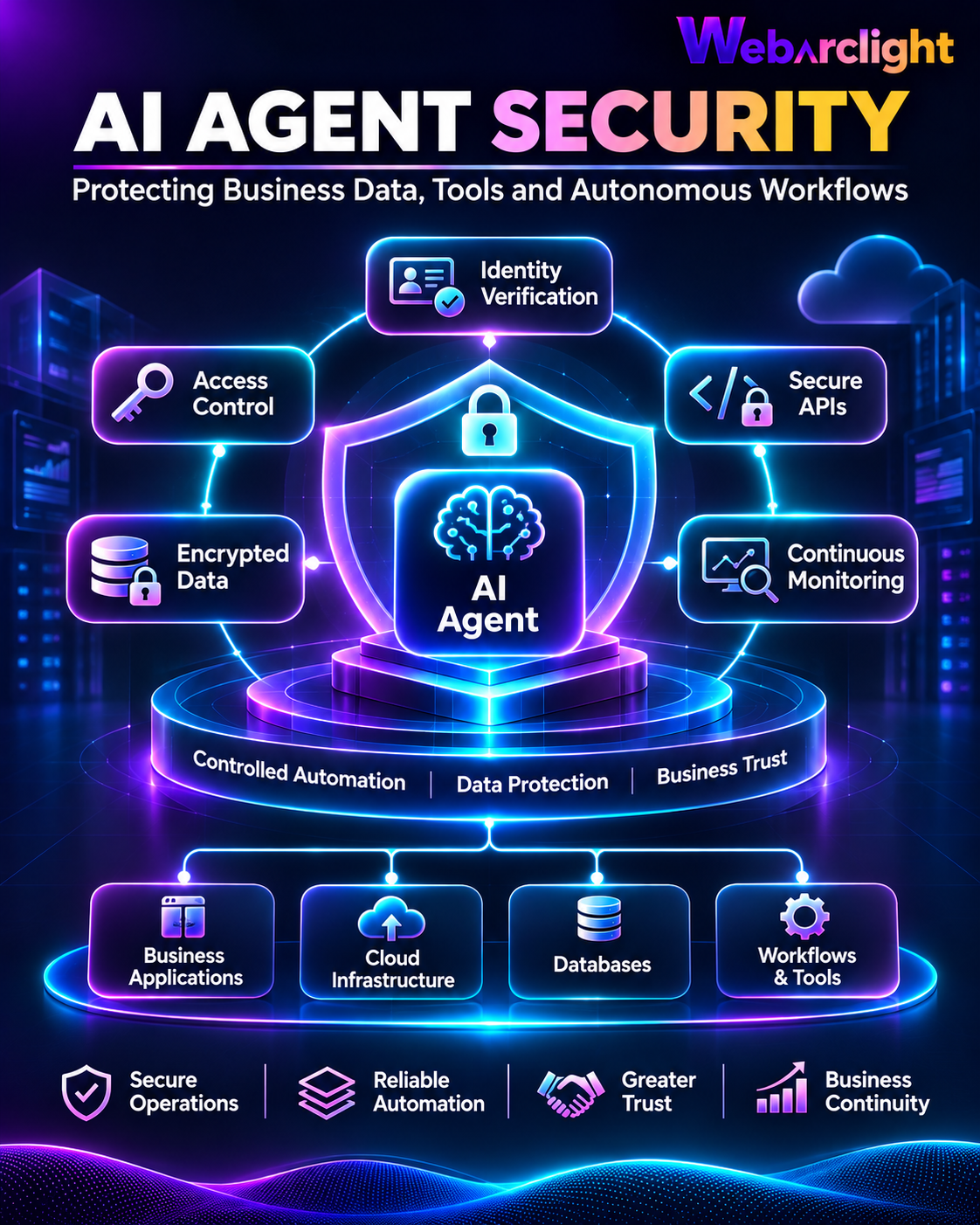
Artificial intelligence is evolving from systems that simply answer questions into intelligent agents capable of accessing information, using external tools and performing tasks across business applications.
AI agents can help organisations automate customer support, analyse business data, manage workflows and coordinate operations. However, as these systems become more autonomous, they also introduce new security challenges.
Unlike traditional software applications, AI agents can interpret instructions, interact with external information and decide which tools to use to complete a task. If these capabilities are not properly controlled, an agent could expose confidential information, execute unauthorised actions or become vulnerable to malicious instructions.
This makes AI agent security an important consideration for every organisation adopting agentic AI.
Businesses need to understand not only what their AI agents can do, but also what they should be allowed to access, which actions they can perform and how their activities are monitored.
1. What Is AI Agent Security?
AI agent security refers to the practices, technologies and controls used to protect AI agents, their connected tools, business data and automated workflows.
Traditional cybersecurity focuses on protecting applications, networks, databases and user accounts. AI agent security extends these protections to systems that can independently interpret instructions and perform actions.
For example, an AI-powered business assistant might have permission to:
• Access customer records from a CRM.
• Retrieve documents from cloud storage.
• Send emails through an integrated application.
• Update information in a business database.
• Communicate with other AI agents.
• Execute approved business workflows.
Each capability introduces a potential security risk if access is not properly restricted.
A secure AI agent should operate within clearly defined permissions, follow approved instructions, protect sensitive information and request human approval when necessary.
In simple terms, AI agent security ensures that intelligent systems can perform useful tasks without gaining unnecessary access or taking unsafe actions.
2. Why Are AI Agents Creating New Security Challenges?
AI agents introduce a different security environment because they combine three important capabilities: access to information, the ability to use tools and a degree of autonomous decision-making.
Consider an AI agent connected to a company's CRM, email platform and internal database.
The agent may be designed to retrieve customer information and prepare responses automatically. However, if it receives manipulated instructions or has excessive permissions, it could access information outside its intended scope or perform an unauthorised action.
Some important factors make these systems challenging to secure:
Autonomous decision-making
AI agents can determine which steps and tools are needed to complete a task. Unexpected decisions may result in actions that were not intended by the developer.
Access to multiple business systems
An agent connected to several applications can potentially expose information across different systems if permissions are not properly managed.
External information and instructions
Agents may process emails, documents, websites and API responses. These sources can contain misleading or malicious instructions.
Agent-to-agent communication
In multi-agent systems, one compromised or manipulated agent may influence other agents through shared information or delegated tasks.
Continuous execution
Some agents can perform multiple actions without requiring approval at every step. This increases the importance of monitoring and execution controls.
As highlighted in the OWASP guidance on AI agent security, these risks include prompt injection, tool misuse, excessive autonomy, data exposure and compromised agent memory.
3. Major Security Risks in AI Agent Systems
Understanding the possible threats is the first step towards building secure AI applications.
1. Prompt Injection Attacks
Prompt injection occurs when malicious instructions are introduced into content processed by an AI agent.
For example, an agent may be asked to summarise a document containing hidden instructions that attempt to redirect its behaviour or make it disclose confidential information.
The agent might follow these instructions if its architecture does not properly separate trusted instructions from untrusted content.
How to reduce the risk:
• Treat external documents and website content as untrusted.
• Separate system instructions from retrieved information.
• Validate sensitive actions independently of model-generated decisions.
• Apply security checks before executing tool calls.
2. Excessive Permissions and Tool Misuse
AI agents often require access to tools, APIs and databases to perform tasks.
However, giving an agent unrestricted access can create serious security problems.
For example, a customer support agent may only need permission to view customer orders. Giving it permission to delete customer records or modify financial information creates unnecessary risk.
How to reduce the risk:
• Apply the principle of least privilege.
• Restrict access to specific tools and operations.
• Separate read-only and write permissions.
• Require approval for sensitive operations.
• Review permissions regularly.
3. Sensitive Data Exposure
AI agents may process personal information, financial records, business documents and confidential customer data.
If this information is exposed through prompts, tool responses, logs or external integrations, it can create privacy and compliance problems.
How to reduce the risk:
• Encrypt sensitive information during storage and transmission.
• Mask or remove unnecessary personal information.
• Restrict access to confidential data.
• Avoid storing sensitive information in unrestricted agent memory.
• Monitor data transfers and external API requests.
4. Agent Identity and Authentication Risks
When multiple agents interact with business applications, it becomes important to identify which agent is requesting access and what permissions it should have.
Using shared credentials or inherited administrator permissions can make it difficult to determine which agent performed an action.
How to reduce the risk:
• Assign unique identities to agents.
• Use secure authentication mechanisms.
• Apply short-lived and task-specific credentials where appropriate.
• Record agent activity.
• Validate permissions at the application or service level.
5. Memory Poisoning
Some AI agents use memory to retain information from previous interactions or tasks.
If malicious or incorrect information enters this memory, it may influence future decisions.
For example, an agent could retain manipulated instructions that affect how it handles later customer requests.
How to reduce the risk:
• Validate information before storing it.
• Separate memory between users and sessions.
• Apply retention and deletion policies.
• Protect stored information against unauthorised modification.
• Review persistent memory for sensitive or suspicious content.
6. Uncontrolled Agent-to-Agent Communication
In multi-agent architectures, agents may delegate tasks and exchange information.
If one agent receives manipulated instructions or produces unreliable results, other agents may act on that information.
This can create cascading failures across an automated workflow.
How to reduce the risk:
• Authenticate communicating agents.
• Validate messages exchanged between agents.
• Define boundaries for delegated tasks.
• Restrict the actions each agent can perform.
• Monitor communication and task execution across the system.
4. How to Secure MCP, A2A and Connected AI Workflows
As discussed in our previous blog, MCP helps AI applications connect with tools and data, while A2A supports communication between independent AI agents.
These protocols make connected AI systems more flexible, but their integrations must be secured.
For example, an MCP-connected agent might access a company database, while an A2A-enabled system allows it to delegate a task to another agent.
Businesses should consider the following controls:
Secure MCP integrations
• Verify the identity and trustworthiness of MCP servers.
• Review the tools and permissions exposed by each server.
• Restrict access to approved resources.
• Validate tool inputs and outputs.
• Monitor tool execution and access activity.
Secure A2A communication
• Authenticate agents before allowing communication.
• Define which agents can delegate tasks to one another.
• Validate information received from other agents.
• Restrict delegated permissions.
• Monitor communication across the agent network.
A connected AI architecture should never assume that an agent or tool is trustworthy simply because it belongs to the same workflow.
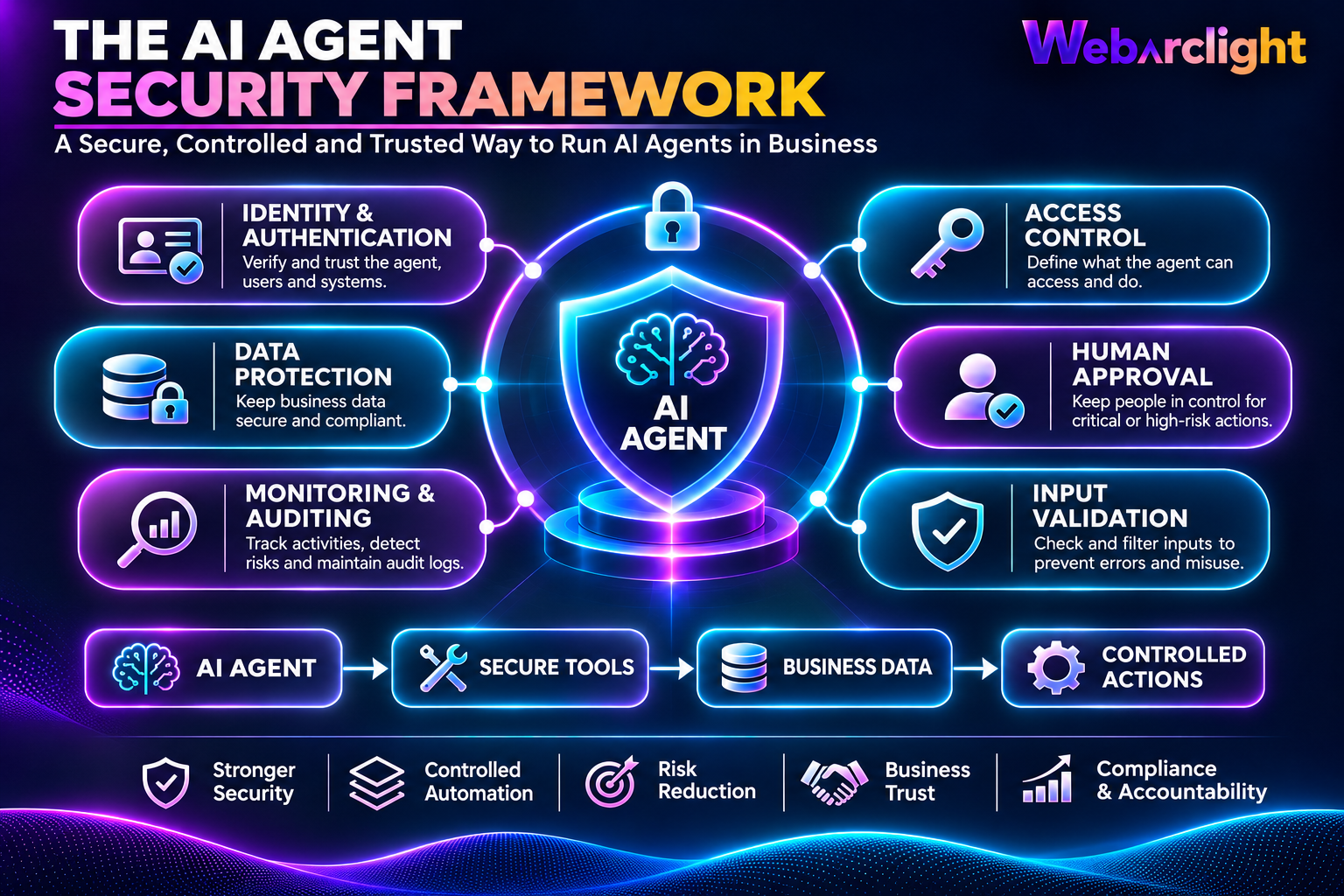
5. Best Practices for Building Secure AI Agents
Businesses can reduce security risks by incorporating protection mechanisms throughout the AI development lifecycle.
Apply the Principle of Least Privilege
Give each agent only the tools, data and permissions necessary to complete its assigned responsibilities.
An agent responsible for analysing reports does not need unrestricted access to financial transactions or administrative settings.
Implement Human-in-the-Loop Approval
Not every action should be performed autonomously.
High-impact activities such as processing payments, deleting records, changing user permissions or sending sensitive communications should require appropriate human authorization.
Use Strong Identity and Access Management
Every agent should have a clearly defined identity and permission scope.
Organisations should implement authentication, authorization and access monitoring to prevent unauthorised activity.
Validate Inputs and Outputs
AI-generated decisions should not automatically be treated as trusted instructions.
Validate tool parameters, API requests, retrieved information and generated outputs before allowing important operations.
Monitor Agent Behaviour
Maintain logs of important agent activities, including:
• Tool calls and API requests.
• Data access and modification.
• Agent-to-agent communication.
• Authentication and authorization events.
• Failed actions and unusual activity.
Monitoring helps organisations detect suspicious behaviour and investigate unexpected outcomes.
Use Sandboxing and Isolation
Run agents in controlled environments with restricted file system access, network permissions and execution capabilities.
This helps limit the impact if an agent behaves unexpectedly or is manipulated.
Establish Clear Governance Policies
Define which tasks agents can perform independently, which require approval and which actions are prohibited.
Security policies should cover development, deployment, monitoring and ongoing maintenance.
6. The Role of Cloud Infrastructure in AI Agent Security
Cloud infrastructure plays an important role in deploying and managing secure AI applications.
Platforms such as Amazon Web Services (AWS) provide services that can support identity management, data protection, application isolation, monitoring and secure AI deployment.
For example:
• AWS IAM: Helps manage identities, roles and permissions.
• AWS KMS: Supports encryption key management.
• Amazon CloudWatch: Provides monitoring and logging capabilities.
• AWS Lambda: Supports isolated execution of application functions.
• Amazon S3: Provides storage with configurable access controls.
• Amazon Bedrock: Provides managed access to foundation models and related AI capabilities.
These services can form part of a secure architecture, but using cloud services alone does not guarantee that an AI agent is secure. Appropriate configurations, access policies and application-level safeguards are still necessary.
Organisations should design security into the complete workflow, from the AI model and agent framework to connected applications and underlying infrastructure.
7. How Businesses Can Prepare for Secure AI Adoption
Businesses do not need to implement complex multi-agent architectures immediately.
A practical approach is to start with a clearly defined use case and introduce security controls from the beginning.
Step 1: Identify the business workflow
Select a repetitive process where AI automation can create measurable value.
Step 2: Define the agent's responsibilities
Specify which tasks the agent can perform and which activities must remain under human control.
Step 3: Identify required data and tools
List the databases, APIs and business applications the agent needs to access.
Step 4: Establish access controls
Create individual permissions and restrict the agent to approved resources and operations.
Step 5: Introduce approval mechanisms
Require human authorization for sensitive or irreversible actions.
Step 6: Test security before deployment
Evaluate prompt injection, data exposure, unauthorized tool usage and unexpected agent behaviour.
Step 7: Monitor and improve continuously
Review agent activity, update permissions and test the system whenever its models, tools or integrations change.
This approach allows organisations to adopt AI automation while maintaining better control over their technology and business data.
8. The Future of AI Agent Security in 2026 and Beyond
As businesses move towards more autonomous AI applications, security will become an essential part of agent architecture rather than a feature added after deployment.
The development of agent identity, authentication, authorization and governance frameworks is gaining importance as organisations explore AI agents across enterprise environments.
Emerging practices are likely to place greater emphasis on:
• Dedicated identities for individual AI agents.
• Fine-grained permissions and task-specific access.
• Secure communication between independent agents.
• Continuous monitoring of autonomous workflows.
• Stronger protection against prompt injection and tool misuse.
• Human oversight for high-impact decisions.
• Security testing throughout the AI development lifecycle.
Organisations adopting platforms such as ChatGPT, Claude AI, AWS Bedrock and other enterprise AI solutions should evaluate their security requirements alongside functionality, performance and cost.
The goal is not simply to build agents that can perform more tasks. It is to build agents that perform the right tasks, with the right permissions, under the right level of supervision.
Conclusion
AI agents are creating new opportunities for business automation, but their ability to access information, use tools and perform autonomous actions also introduces important security challenges.
Prompt injection, excessive permissions, sensitive data exposure, compromised memory and unsafe agent communication can affect the reliability and security of AI-powered systems.
Businesses should address these risks through strong identity management, least-privilege access, human approval, secure integrations, monitoring and continuous testing.
As agentic AI becomes more widely adopted, security will be a fundamental requirement for building trustworthy and scalable AI applications.
At WebArclight, we help businesses explore secure AI applications, cloud infrastructure and intelligent automation solutions designed around real business requirements.
https://webarclight.com/
Comments
The world hopes for more passionate writers such as you who are not afraid to say how they
believe. Always go after your heart.
Also visit my web blog <a href="http://advokat-po-ugolovnomu-delu.ru/forums/topic/7623/|http://auropedia.com/index.php/User:EarlPalombo3|http://crativ.co.kr/bbs/board.php?bo_table=info1&wr_id=205895|http://injurycliniconline.com/groups/%ed%99%8d%eb%b3%b4%ec%9a%a9-%ec%82%ac%ec%a7%84-%ec%86%8d-%ec%97%b0%ec%b6%9c%ea%b3%bc-%ec%8b%a4%ec%a0%9c-%ec%9c%a0%ed%9d%a5-%ea%b3%b5%ea%b0%84%ec%9d%98-%ec%b0%a8%ec%9d%b4%eb%a5%bc-%ea%b5%ac%eb%b6%84/|http://rlservice.ru/forums/topic/16079/|http://sbtec.kr/bbs/board.php?bo_table=0401&wr_id=106885|http://thinmarker.club/index.php/User:AjaStansbury|http://toyota-stmotors.ru/avtoservis/%ed%99%8d%eb%b3%b4%ec%9a%a9-%ec%82%ac%ec%a7%84-%ec%86%8d-%ec%97%b0%ec%b6%9c%ea%b3%bc-%ec%8b%a4%ec%a0%9c-%ec%9c%a0%ed%9d%a5-%ea%b3%b5%ea%b0%84%ec%9d%98-%ec%b0%a8%ec%9d%b4%eb%a5%bc-%ea%b5%ac%eb%b6%84/|http://www.cericot.it/node/add/faq?------WebKitFormBoundaryogCZXpwzeYvJAoaF%0D%0AContent-Disposition:%20form-data;%20name=%22title%22%0D%0A%0D%0A%EB%B6%80%EB%8B%B4%EC%8A%A4%EB%9F%AC%EC%9A%B4%20%EC%A3%BC%EC%A0%9C%EB%A5%BC%20%EC%9E%90%EC%97%B0%EC%8A%A4%EB%9F%BD%EA%B2%8C%20%EB%84%98%EA%B8%B0%EB%8A%94%20%EC%86%8C%ED%86%B5%EC%9D%98%20%EA%B8%B0%EC%88%A0%0D%0A------WebKitFormBoundaryogCZXpwzeYvJAoaF%0D%0AContent-Disposition:%20form-data;%20name=%22taxonomy[2]%22%0D%0A%0D%0A7%0D%0A------WebKitFormBoundaryogCZXpwzeYvJAoaF%0D%0AContent-Disposition:%20form-data;%20name=%22teaser_include%22%0D%0A%0D%0A1%0D%0A------WebKitFormBoundaryogCZXpwzeYvJAoaF%0D%0AContent-Disposition:%20form-data;%20name=%22body%22%0D%0A%0D%0A%3C/p%3E%3Cbr%3E%0D%0A%3Cbr%3E%0D%0A%0D%0A%3Cp%3E%3Cp%3E%EC%88%A0%EC%9E%90%EB%A6%AC%EB%82%98%20%EC%82%AC%EC%A0%81%EC%9D%B8%20%EC%9E%90%EB%A6%AC%EC%97%90%EC%84%9C%20%EC%9B%90%EC%B9%98%20%EC%95%8A%EB%8A%94%20%EC%A7%88%EB%AC%B8%EC%9D%84%20%EB%B0%9B%EC%9D%84%20%EB%95%8C%EA%B0%80%20%EC%9E%88%EC%96%B4%EC%9A%94.%20%EC%86%8D%EB%A7%88%EC%9D%8C%EC%9D%84%20%EB%8B%A4%20%EC%97%B4%EC%96%B4%EB%86%93%EA%B8%B0%EC%97%94%20%EB%B6%80%EB%8B%B4%EC%8A%A4%EB%9F%AC%EC%9A%B4%20%EC%88%9C%EA%B0%84%EC%9D%B4%EC%A3%A0.%20%EA%B0%95%ED%95%98%EA%B2%8C%20%EA%B1%B0%EC%A0%88%ED%95%98%EA%B8%B0%EB%B3%B4%EB%8B%A4%20%EB%B6%84%EC%9C%84%EA%B8%B0%EB%A5%BC%20%EA%B9%A8%EC%A7%80%20%EC%95%8A%EC%9C%BC%EB%A9%B0%20%EB%84%98%EA%B8%B0%EB%8A%94%20%EB%B0%A9%EB%B2%95%EC%9D%84%20%EA%B3%A0%EB%AF%BC%ED%95%98%EA%B2%8C%20%EB%8F%BC%EC%9A%94.%3C/p%3E%3Cbr%3E%0D%0A%3Cbr%3E%0D%0A%0D%0A%3Cbr%3E%0D%0A%3Cbr%3E%0D%0A%0D%0A%3Cp%3E%EC%9E%90%EC%8B%A0%EC%9D%98%20%ED%8E%B8%EC%95%88%ED%95%A8%EC%9D%84%20%EA%B0%80%EC%9E%A5%20%EB%A8%BC%EC%A0%80%20%EB%91%90%EB%8A%94%20%EA%B2%83%EC%9D%B4%20%EC%B2%AB%20%EB%B2%88%EC%A7%B8%20%EA%B8%B0%EC%A4%80%EC%9D%B4%EC%97%90%EC%9A%94.%20%EC%83%81%EB%8C%80%EC%9D%98%20%EC%A7%88%EB%AC%B8%EC%97%90%20%EC%99%84%EB%B2%BD%ED%95%98%EA%B2%8C%20%EB%8B%B5%ED%95%B4%EC%A4%84%20%ED%95%84%EC%9A%94%EB%8A%94%20%EC%A0%84%ED%98%80%20%EC%97%86%EC%96%B4%EC%9A%94.%20%EC%A7%A7%EA%B3%A0%20%EC%A7%A7%EA%B2%8C%20%EC%9D%91%EB%8C%80%ED%95%98%EB%A9%B4%EC%84%9C%20%EB%8B%A4%EB%A5%B8%20%EC%9D%B4%EC%95%BC%EA%B8%B0%EB%A1%9C%20%EC%A3%BC%EC%A0%9C%EB%A5%BC%20%EB%8F%8C%EB%A6%AC%EB%8A%94%20%EA%B8%B0%EC%88%A0%EC%9D%B4%20%EC%9C%A0%EC%9A%A9%ED%95%B4%EC%9A%94.%3C/p%3E%3Cbr%3E%0D%0A%3Cbr%3E%0D%0A%0D%0A%3Cbr%3E%0D%0A%3Cbr%3E%0D%0A%0D%0A%3Cp%3E%EC%83%81%EB%8C%80%EB%B0%A9%EC%9D%B4%20%EB%B0%B0%EB%A0%A4%EC%8B%AC%20%EA%B9%8A%EA%B2%8C%20%EB%B0%98%EC%9D%91%ED%95%B4%EC%A3%BC%EB%8A%94%20%ED%99%98%EA%B2%BD%EC%9D%B4%EB%9D%BC%EB%A9%B4%20%EB%8C%80%ED%99%94%EB%8A%94%20%ED%9B%A8%EC%94%AC%20%ED%8E%B8%ED%95%B4%EC%A0%B8%EC%9A%94.%20%ED%98%84%EC%9E%A5%EC%9D%84%20%EC%9E%98%20%EC%BC%80%EC%96%B4%ED%95%98%EB%8A%94%20%EC%88%98%ED%98%84%EC%8B%A4%EC%9E%A5%20%EA%B0%99%EC%9D%80%20%EC%A1%B4%EC%9E%AC%EA%B0%80%20%EC%9E%88%EB%8B%A4%EB%A9%B4%20%EB%A7%88%EC%9D%8C%20%ED%8E%B8%ED%9E%88%20%EB%B6%84%EC%9C%84%EA%B8%B0%EC%97%90%20%EC%A7%91%EC%A4%91%ED%95%A0%20%EC%88%98%20%EC%9E%88%EC%A3%A0.%20%3Ca%20href=%22https://club.isweb.co.kr/%22%3E%EA%B1%B4%EB%8C%80%20%EB%B0%A9%EB%AC%B8%20%EC%A0%84%20%ED%99%95%EC%9D%B8%EC%82%AC%ED%95%AD%3C/a%3E%ED%98%B8%EC%8A%A4%ED%8A%B8%EB%B0%94%20%EB%A7%A4%EC%9E%A5%EC%9D%84%20%EC%B0%BE%EC%9D%84%20%EB%95%8C%EB%8F%84%20%EC%84%9C%EB%A1%9C%20%EC%98%88%EC%9D%98%EB%A5%BC%20%EC%A7%80%ED%82%A4%EB%8A%94%20%EB%8C%80%ED%99%94%EA%B0%80%20%EA%B8%B0%EB%B3%B8%EC%9D%B4%EC%97%90%EC%9A%94.%20%EA%B2%BD%EA%B3%84%EB%A5%BC%20%ED%91%9C%ED%98%84%ED%95%98%EB%8A%94%20%EA%B2%83%EC%9D%B4%20%EB%AC%B4%EB%A1%80%ED%95%9C%20%ED%96%89%EB%8F%99%EC%9D%80%20%EC%95%84%EB%8B%88%EB%8B%88%20%EC%95%88%EC%8B%AC%ED%95%B4%EB%8F%84%20%EB%8F%BC%EC%9A%94.%20%EA%B0%80%EB%B3%8D%EA%B2%8C%20%EC%96%B4%EA%B9%A8%EB%A5%BC%20%EC%9C%BC%EC%93%B1%ED%95%98%EA%B1%B0%EB%82%98%20%EB%8B%A4%EC%9D%8C%20%EA%B8%B0%ED%9A%8C%EB%A1%9C%20%EB%AF%B8%EB%A3%A8%EB%8A%94%20%EB%A7%90%20%ED%95%9C%EB%A7%88%EB%94%94%EB%A9%B4%20%EC%B6%A9%EB%B6%84%ED%95%B4%EC%9A%94.%3C/p%3E%3Cbr%3E%0D%0A%3Cbr%3E%0D%0A%0D%0A%3Cbr%3E%0D%0A%3Cbr%3E%0D%0A%0D%0A%3Cp%3E%EB%8C%80%ED%99%94%EB%8A%94%20%EC%84%9C%EB%A1%9C%EC%9D%98%20%EA%B2%BD%EA%B3%84%EB%A5%BC%20%EC%A7%80%EC%BC%9C%EC%A4%84%20%EB%95%8C%20%EB%8D%94%EC%9A%B1%20%EC%A6%90%EA%B1%B0%EC%9B%8C%EC%A0%B8%EC%9A%94.%20%EC%9E%90%EC%8B%A0%EB%A7%8C%EC%9D%98%20%EA%B8%B0%EC%A4%80%EC%9D%84%20%EA%B0%80%EC%A7%80%EA%B3%A0%20%ED%8E%B8%EC%95%88%ED%95%9C%20%EA%B1%B0%EB%A6%AC%EB%A5%BC%20%EC%A7%80%EC%BC%9C%EB%B3%B4%EC%84%B8%EC%9A%94.%3C/p%3E%3Cbr%3E%0D%0A%3Cbr%3E%0D%0A%0D%0A%3C/p%3E%0D%0A------WebKitFormBoundaryogCZXpwzeYvJAoaF%0D%0AContent-Disposition:%20form-data;%20name=%22changed%22%0D%0A%0D%0A%0D%0A------WebKitFormBoundaryogCZXpwzeYvJAoaF%0D%0AContent-Disposition:%20form-data;%20name=%22form_build_id%22%0D%0A%0D%0Aform-5oRuuMXzsTUa99J9kg6fcUzlRuRWmodMDQklztelQ38%0D%0A------WebKitFormBoundaryogCZXpwzeYvJAoaF%0D%0AContent-Disposition:%20form-data;%20name=%22form_id%22%0D%0A%0D%0Afaq_node_form%0D%0A------WebKitFormBoundaryogCZXpwzeYvJAoaF%0D%0AContent-Disposition:%20form-data;%20name=%22detailed_question%22%0D%0A%0D%0A22%0D%0A------WebKitFormBoundaryogCZXpwzeYvJAoaF%0D%0AContent-Disposition:%20form-data;%20name=%22op%22%0D%0A%0D%0ASalva%0D%0A------WebKitFormBoundaryogCZXpwzeYvJAoaF--|http://www.macstudio.co.kr/?document_srl=3741694|https://2084books.com/forums/topic/%ea%b8%b0%eb%85%90%ec%9d%bc-%eb%aa%a8%ec%9e%84-%ec%9e%a5%ec%86%8c-%ed%99%94%eb%a0%a4%ed%95%9c-%ec%9d%b4%eb%b2%a4%ed%8a%b8%eb%b3%b4%eb%8b%a4-%ec%b7%a8%ed%96%a5-%ec%a1%b0%ec%9c%a8%ec%9d%b4/|https://cursosenlinea.world-reach.org/forums/topic/%ec%98%a8%eb%9d%bc%ec%9d%b8-%ec%a0%95%eb%b3%b4%eb%a7%8c%ec%9c%bc%eb%a1%9c-%ec%95%8c%ea%b8%b0-%ed%9e%98%eb%93%a0-%ed%98%b8%ec%8a%a4%ed%8a%b8%eb%b0%94-%ec%8b%a4%eb%82%b4-%ea%b5%ac%ec%84%b1-%ec%9a%94/|https://edu-portals.xyz/index.php/User:ForrestLudwig|https://edutransform.pk/forums/topic/%ec%98%a8%eb%9d%bc%ec%9d%b8%ec%97%90-%ec%98%ac%eb%9d%bc%ec%98%a8-%ed%98%b8%ec%8a%a4%ed%8a%b8%eb%b0%94-%ed%9b%84%ea%b8%b0-%eb%82%b4-%ec%83%81%ed%99%a9%ec%97%90-%eb%a7%9e%ea%b2%8c-%ea%b0%80%eb%a0%a4/|https://neoplasm.org/index.php/User:LawrenceFlinders|https://phakamainternational.com/%ea%b4%91%ea%b3%a0%ec%84%b1-%ea%b8%80%ea%b3%bc-%ec%8b%a4%ec%a7%88%ec%a0%81%ec%9d%b8-%ed%8c%81%ec%9d%84-%ea%b5%ac%eb%b6%84%ed%95%b4-%eb%82%98%eb%a7%8c%ec%9d%98-%ec%84%a0%ed%83%9d%ec%9d%84-%eb%82%b4/|https://s-nature-m.com/forums/topic/%ed%99%94%eb%a0%a4%ed%95%9c-%ec%a1%b0%eb%aa%85-%ec%82%ac%ec%a7%84-%eb%92%a4%ec%97%90-%ec%88%a8%ea%b2%a8%ec%a7%84-%ec%8b%a4%ec%a0%9c-%eb%82%b4%eb%b6%80-%ea%b3%b5%ea%b0%84%ec%9d%98-%eb%8f%99%ec%84%a0/|https://www.integramais.com.br/2026/11/17/%eb%8f%99%ec%84%a0-%ed%8c%8c%ec%95%85%ec%9d%b4-%ed%95%b5%ec%8b%ac%ec%9d%b8-%ec%a0%80%eb%85%81-%eb%aa%a8%ec%9e%84-%ec%9e%a5%ec%86%8c%ec%9d%98-%ec%98%ac%eb%b0%94%eb%a5%b8-%ed%99%95%ec%9d%b8-%ea%b8%b0/|https://www.lawinjustice.com/node/94220|https://www.warcraftforever.wiki/wiki/User:CelesteStrayer1|https://www.wiki.showcad.dotnetcloud.co.uk/index.php?title=User:EmiliaRnx8815">건대w</a>
topics. Traffic grows more easily but leads matter
more, and balancing the two shapes the whole plan.
My site - <a href="https://www.facebook.com/gsaserverifiedlists/">GSA SER list quality</a>